
PowerPoint presentations are widely used for training materials, product demos, online courses, and business reporting. However, sharing raw PPT or PPTX files can be problematic—recipients may not have PowerPoint installed, animations may not play correctly, and manual exporting becomes inefficient for bulk processing.
Converting PowerPoint to video formats like MP4 or WMV solves these challenges by creating universally playable content that preserves formatting and animations. With Spire.Presentation from e-iceblue, developers can automate PowerPoint-to-video conversion programmatically without requiring Microsoft PowerPoint installation.
This article demonstrates how to convert PowerPoint presentations to MP4 and WMV video in C# using Spire.Presentation for .NET, including configuration options for frame rate, slide duration, and transition preservation.
1. Why Convert PowerPoint to Video Programmatically?
Developers often need to convert PowerPoint presentations to video as part of larger business workflows. Compared with manually exporting files in Microsoft PowerPoint, programmatic conversion offers more flexibility and scalability.
Common scenarios include:
- Automatically converting uploaded PPT/PPTX files into MP4 videos in web applications
- Batch-processing training presentations for LMS platforms
- Generating product demo videos from presentation templates
- Converting presentations on servers where Microsoft PowerPoint is not installed
- Standardizing presentation delivery across different devices
Programmatic conversion is especially useful when you need repeatable workflows, server-side processing, or integration with existing document automation systems.
2. Set Up the Environment
Before converting PowerPoint presentations to video, you need to prepare two components:
- Spire.Presentation for .NET – used to load and process PPT/PPTX files
- FFmpeg – used to encode slide frames into MP4 or WMV video files
Spire handles presentation rendering, while FFmpeg generates the final video output. Both are required for successful conversion.
Install Spire.Presentation for .NET
Install the library from NuGet:
Install-Package Spire.Presentation
You can also download Spire.Presentation for .NET package and install it manually.
This package allows your C# application to open PowerPoint presentations, access slides, and export them programmatically.
Install FFmpeg
Spire.Presentation relies on FFmpeg to combine rendered slide frames into a playable video file. If FFmpeg is not installed or the path is configured incorrectly, the export process will fail.
- On Windows
Follow these steps to install FFmpeg:
-
Download the FFmpeg essentials build
-
Extract the package to your local machine
-
Locate the bin folder path
Example:
D:\tools\ffmpeg\bin
This path will be used later when configuring SaveToVideoOption.
- On Linux (CentOS)
Install FFmpeg using the following commands:
sudo yum install epel-release
sudo yum localinstall --nogpgcheck https://download1.rpmfusion.org/free/el/rpmfusion-free-release-7.noarch.rpm
sudo yum install ffmpeg ffmpeg-devel
After installation, you can run the following command to locate the FFmpeg path:
which ffmpeg
Note: Older FFmpeg versions may not fully support certain slide transition effects.
3. Convert PowerPoint to MP4 in C#
Once the environment is configured, you can convert PowerPoint presentations to MP4 using just a few lines of code.
The basic workflow includes:
- Load the PowerPoint file
- Configure video export settings
- Export the presentation as MP4
Basic Conversion Example
The following example converts a PPTX file into an MP4 video:
using Spire.Presentation;

namespace PowerPointToVideo
{
    class Program
    {
        static void Main(string[] args)
        {
            string inputFile = "ProductDemo.pptx";
            string outputFile = "ProductDemo.mp4";

            Presentation presentation = new Presentation();
            presentation.LoadFromFile(inputFile);

            presentation.SaveToVideoOption = new SaveToVideoOption(
                @"D:\tools\ffmpeg\bin"
            );

            presentation.SaveToVideoOption.Fps = 30;
            presentation.SaveToVideoOption.DurationForEachSlide = 2;

            presentation.SaveToFile(outputFile, FileFormat.MP4);

            presentation.Dispose();
        }
    }
}
After running the code:
- The PPTX file is loaded into memory
- Each slide is rendered as individual video frames
- FFmpeg combines the frames into a final MP4 file
- Supported animations, transitions, and embedded videos are preserved during export
Below is a sample PowerPoint presentation along with its converted video output.
Input: PowerPoint Presentation
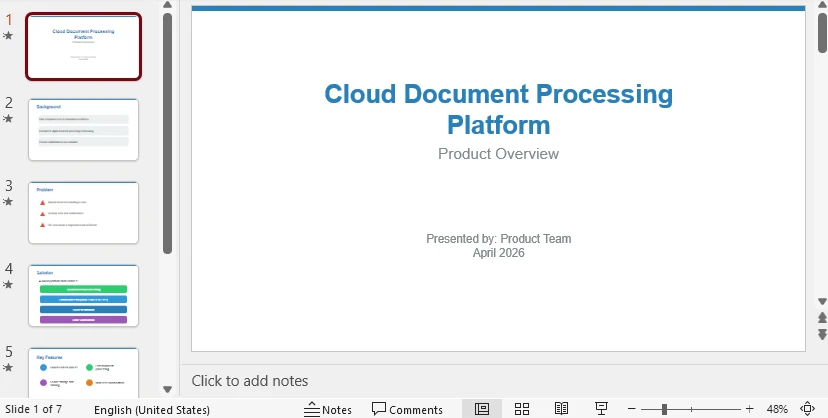
Output: Converted MP4 Video
Click the preview above to watch how PowerPoint slides are converted into an MP4 video while preserving transitions and animations.
How the Core API Works
This example uses several key API methods:
- LoadFromFile() loads the PowerPoint presentation into memory
- SaveToVideoOption configures the FFmpeg path and playback settings
- Fps controls video smoothness
- DurationForEachSlide controls how long each slide appears
- SaveToFile() exports the final video file
- Dispose() releases system resources after conversion
This basic workflow is enough for most standard PowerPoint-to-video conversion tasks. If you need additional formats or customization options, continue to the advanced scenarios below.
If you need a static sharing format, you can also convert PowerPoint presentations to images (JPG/PNG) in C# for easier distribution and web display.
4. More PowerPoint to Video Options in C#
The basic example works for most scenarios, but some applications may require different output formats, custom playback settings, or bulk conversion workflows.
Convert PowerPoint to WMV
While MP4 is the most widely used video format, some legacy enterprise systems and Windows-based environments may still require WMV output.
To export a PowerPoint file as WMV, simply change the output file extension:
using Spire.Presentation;

Presentation presentation = new Presentation();
presentation.LoadFromFile("TrainingSlides.pptx");

presentation.SaveToVideoOption = new SaveToVideoOption(
    @"D:\tools\ffmpeg\bin"
);

presentation.SaveToFile("TrainingVideo.wmv", FileFormat.WMV);

presentation.Dispose();
Customize Video Settings
If your presentation contains complex animations or requires specific playback timing, you can adjust frame rate and slide duration settings.
using Spire.Presentation;

Presentation presentation = new Presentation();
presentation.LoadFromFile("MarketingPitch.pptx");

presentation.SaveToVideoOption = new SaveToVideoOption(
    @"D:\tools\ffmpeg\bin"
);

// Higher FPS for smoother playback
presentation.SaveToVideoOption.Fps = 60;

// Longer display time per slide
presentation.SaveToVideoOption.DurationForEachSlide = 10;

presentation.SaveToFile("MarketingPitch_HD.mp4", FileFormat.MP4);

presentation.Dispose();
Video Settings Reference
| Setting | Default | Maximum | Purpose |
|---|---|---|---|
| Fps | 30 | 60 | Controls playback smoothness |
| DurationForEachSlide | 5 seconds | 5 minutes | Controls slide display duration |
Higher values may increase processing time and temporary storage usage.
Batch Convert Multiple PPTX Files
Batch conversion is useful for LMS platforms, enterprise reporting systems, and document automation workflows that need to process multiple presentations automatically.
using Spire.Presentation;
using System.IO;

string ffmpegPath = @"D:\tools\ffmpeg\bin";
string inputFolder = @"C:\Presentations\";
string outputFolder = @"C:\Videos\";

string[] pptxFiles = Directory.GetFiles(inputFolder, "*.pptx");

foreach (string inputFile in pptxFiles)
{
    string fileName = Path.GetFileNameWithoutExtension(inputFile);
    string outputFile = Path.Combine(outputFolder, fileName + ".mp4");

    Presentation presentation = new Presentation();
    presentation.LoadFromFile(inputFile);

    presentation.SaveToVideoOption = new SaveToVideoOption(ffmpegPath);
    presentation.SaveToVideoOption.Fps = 30;
    presentation.SaveToVideoOption.DurationForEachSlide = 3;

    presentation.SaveToFile(outputFile, FileFormat.MP4);
    presentation.Dispose();
}
This approach helps automate large-scale PowerPoint-to-video conversion workflows without requiring manual exports in Microsoft PowerPoint.
You can edit the PowerPoint presentation in C# before conversion to ensure the resulting video has better layout and animation effects.
5. Supported Transitions and Animations
During PowerPoint-to-video conversion, Spire.Presentation preserves key visual effects to ensure the output video closely matches the original presentation experience.
Slide Transitions
PowerPoint slide transitions are rendered during video generation to maintain smooth visual flow between slides.
The following transitions are supported:
- Fade
- Push
- Wipe (up, down, left, right)
- Reveal
- Cover
- Split
- Dissolve
- Clockwise Clock
These transitions are applied during frame rendering to simulate natural slide progression in the final video.
Animation Effects
Animations are processed and rendered during video generation to simulate PowerPoint playback behavior.
Entrance Animations:
- Fly In
- Float In
- Appear
- Fade
- Split
- Wipe
Exit Animations:
- Fly Out
- Float Out
- Disappear
- Fade
- Split
- Wipe
Animation sequences are processed as a single playback unit to ensure consistent rendering in the final video.
Additional Features
- Embedded Videos
Embedded media inside PowerPoint slides is included in the exported video, making it suitable for presentations with multimedia content.
- Automatic Duration Handling
Slide timing and animation durations are automatically interpreted during conversion to ensure accurate playback in the final video output.
- Cross-Platform Support
The conversion process can run on both Windows and Linux environments, making it suitable for server-side automation and enterprise workflows.
For more information on supported features, refer to the Spire.Presentation for .NET API documentation.
6. Common Pitfalls
When converting PowerPoint presentations to video, there are a few common issues that may affect output quality or runtime execution. Being aware of these helps ensure a smoother conversion process in production environments.
FFmpeg Path Not Found
The video export process depends on FFmpeg for encoding the final MP4 or WMV file.
Ensure that the FFmpeg path is correctly configured and points to the bin directory containing the FFmpeg executable.
On Windows, this typically looks like:
D:\tools\ffmpeg\bin
If the FFmpeg path is incorrect or not accessible, the video export process will fail at runtime.
Insufficient Disk Space
PowerPoint-to-video conversion involves rendering slides into intermediate frames before encoding them into a final video file.
As a result, disk usage may increase significantly depending on:
- Number of slides
- Slide duration
- Frame rate (FPS)
- Presentation resolution and content complexity
For high-quality or long-duration presentations, temporary disk usage can become substantial. It is recommended to ensure sufficient free disk space before processing large batch conversions.
Unsupported or Inconsistent Transitions
Most common PowerPoint transitions are supported during conversion. However, some complex or advanced transition effects may not be rendered exactly the same as in Microsoft PowerPoint.
In such cases, the final video will still preserve slide flow, but the visual effect may appear simplified compared to the original presentation.
It is recommended to test presentations with advanced transitions before using them in production workflows.
Font Rendering Differences
PowerPoint presentations rely on system-installed fonts. If a required font is missing on the environment where conversion is executed, the layout or text appearance in the final video may change.
To ensure consistent rendering:
- Install required fonts on the system
- Use widely available standard fonts when possible
- Verify output on target deployment environments
This is especially important for multilingual presentations or server-side conversion scenarios.
Conclusion
In this article, we demonstrated how to convert PowerPoint presentations to MP4 and WMV video in C# using Spire.Presentation. By leveraging the Spire API, developers can automate video generation with customizable frame rates, slide durations, and transition preservation.
Beyond video conversion, Spire.Presentation can also be used for tasks such as slide editing, media extraction, and presentation generation, making it useful for broader document automation workflows.
If you would like to evaluate the full functionality without limitations, you can apply for a temporary license.
FAQ
Can I convert PowerPoint to MP4 without Microsoft PowerPoint?
Yes. Spire.Presentation performs conversion independently and does not require Microsoft PowerPoint installation.
Are animations preserved in the video?
Yes, many common slide transitions and entrance/exit animations are preserved during conversion.
What video formats are supported?
Currently, MP4 and WMV formats are supported for video export.
Is Spire.Presentation suitable for server-side applications?
Yes. Spire.Presentation supports server environments and is widely used in automated document processing workflows.
How much disk space does video conversion require?
Video generation creates temporary image frames. A presentation with 5 slides at 60 FPS and 5-minute duration may require approximately 25GB of temporary storage.
