C#/VB.NET: Convert Charts in Excel to Images
Charts are commonly used in Microsoft Excel files to visualize numeric data. In some cases, you may need to save the charts in an Excel file as images in order to use them in other programs or other files such as PDFs and PowerPoint presentations. In this article, we will demonstrate how to convert charts in Excel to images in C# and VB.NET using Spire.XLS for .NET.
- Convert a Specific Chart in an Excel Worksheet to Image
- Convert All Charts in an Excel Worksheet to Images
- Convert a Chart Sheet to Image in Excel
Install Spire.XLS for .NET
To begin with, you need to add the DLL files included in the Spire.XLS for .NET package as references in your .NET project. The DLLs files can be either downloaded from this link or installed via NuGet.
PM> Install-Package Spire.XLS
Convert a Specific Chart in an Excel Worksheet to Image in C# and VB.NET
Spire.XLS provides the Workbook.SaveChartAsImage(Worksheet worksheet, int chartIndex) method which enables you to convert a specific chart in a worksheet as image. The following are the detailed steps:
- Initialize an instance of the Workbook class.
- Load a sample Excel file using Workbook.LoadFromFile() method.
- Get a specific worksheet by its index through Workbook.Worksheets[int worksheetIndex] property.
- Save a specific chart in the worksheet as image using Workbook.SaveChartAsImage(Worksheet worksheet, int chartIndex) method.
- Save the image to a PNG file.
- C#
- VB.NET
using Spire.Xls;
using System.Drawing;
using System.Drawing.Imaging;

namespace ConvertAExcelChartToImage
{
    internal class Program
    {
        static void Main(string[] args)
        {
            //Initialize an instance of the Workbook class
            Workbook workbook = new Workbook();
            //Load a sample Excel file
            workbook.LoadFromFile("Charts.xlsx");

            //Get the first worksheet
            Worksheet sheet = workbook.Worksheets[0];

            //Save the first chart in the first worksheet as image
            Image image = workbook.SaveChartAsImage(sheet, 0);
            //Save the image to .png file
            image.Save(@"output\chart.png", ImageFormat.Png);
        }
    }
}

Convert All Charts in an Excel Worksheet to Images in C# and VB.NET
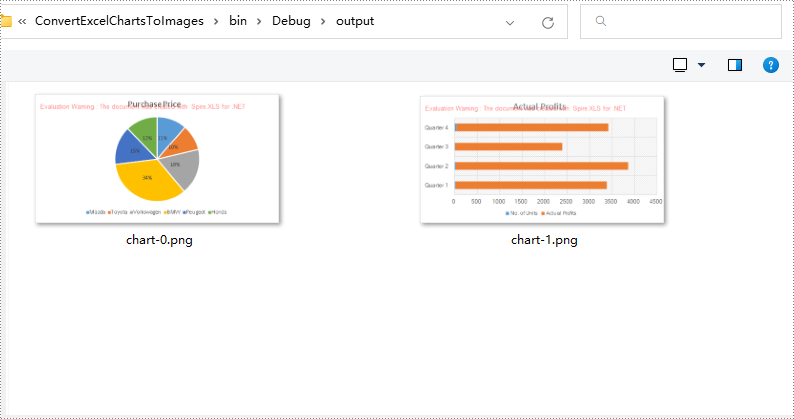
To convert all charts in an Excel worksheet to images, you can use the Workbook.SaveChartAsImage(Worksheet worksheet) method. The following are the detailed steps:
- Initialize an instance of the Workbook class.
- Load a sample Excel file using Workbook.LoadFromFile() method.
- Get a specific worksheet by its index through Workbook.Worksheets[int worksheetIndex] property.
- Save all charts in the worksheet as images using Workbook.SaveChartAsImage(Worksheet worksheet) method.
- Save the images to PNG files.
- C#
- VB.NET
using Spire.Xls;
using System.Drawing;
using System.Drawing.Imaging;

namespace ConvertAllExcelChartsToImages
{
    internal class Program
    {
        static void Main(string[] args)
        {
            //Initialize an instance of the Workbook class
            Workbook workbook = new Workbook();
            //Load a sample Excel file
            workbook.LoadFromFile("Charts.xlsx");

            //Get the first worksheet
            Worksheet sheet = workbook.Worksheets[0];

            //Save charts in the first worksheet as images
            Image[] imgs = workbook.SaveChartAsImage(sheet);

            //Save the images to png files
            for (int i = 0; i < imgs.Length; i++)
            {
                imgs[i].Save(string.Format(@"output\chart-{0}.png", i), ImageFormat.Png);
            }
        }
    }
}
Convert a Chart Sheet to Image in Excel in C# and VB.NET
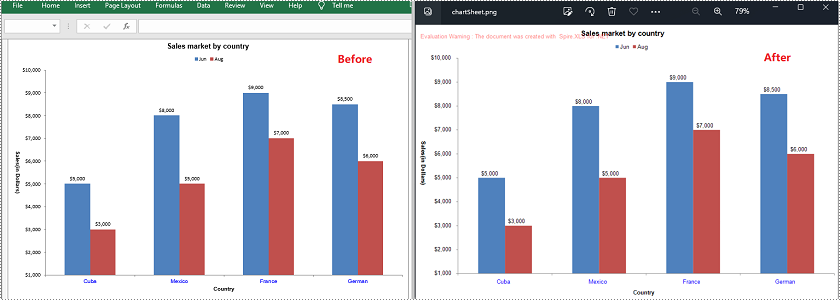
You can use the Workbook.SaveChartAsImage(ChartSheet chartSheet) method to convert a chart sheet in Excel to image. The following are the detailed steps:
- Initialize an instance of the Workbook class.
- Load a sample Excel file using Workbook.LoadFromFile() method.
- Get a specific chart sheet by its index through Workbook.Chartsheets[int chartSheetIndex] property.
- Save the chart sheet as image using Workbook.SaveChartAsImage(ChartSheet chartSheet) method.
- Save the image to .png file.
- C#
- VB.NET
using Spire.Xls;
using System.Drawing;
using System.Drawing.Imaging;

namespace ConvertExcelChartSheetToImage
{
    internal class Program
    {
        static void Main(string[] args)
        {
            //Initialize an instance of the Workbook class
            Workbook workbook = new Workbook();
            //Load a sample Excel file
            workbook.LoadFromFile("ChartSheet.xlsx");

            //Get the first chart sheet
            ChartSheet chartSheet = workbook.Chartsheets[0];

            //Save the first chart sheet as image
            Image image = workbook.SaveChartAsImage(chartSheet);
            //Save the image to .png file
            image.Save(@"output\chartSheet.png", ImageFormat.Png);
        }
    }
}
Apply for a Temporary License
If you'd like to remove the evaluation message from the generated documents, or to get rid of the function limitations, please request a 30-day trial license for yourself.
Convert Excel Sheet to a High-Resolution Image in C#, VB.NET
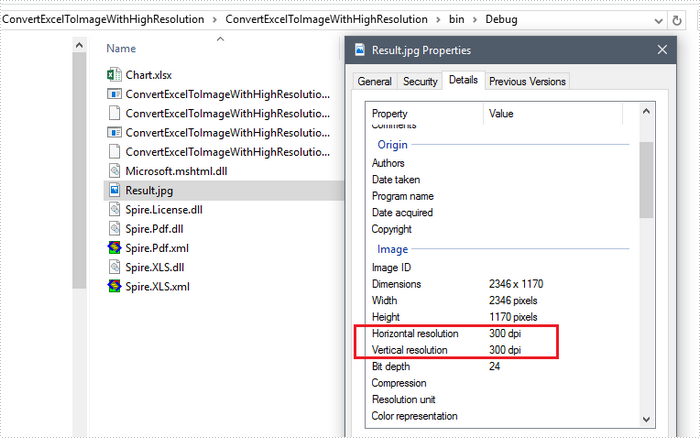
Sometimes, you may want to convert Excel sheet to a high-resolution image, especially when the Excel report contains graphs or pictures. This article will show you how to set image resolution when saving Excel sheet to JPG using Spire.XLS.
Step 1: Create a custom function that you can use to reset the image resolution.
private static Bitmap ResetResolution(Metafile mf, float resolution)
{
    int width = (int)(mf.Width * resolution / mf.HorizontalResolution);
    int height = (int)(mf.Height * resolution / mf.VerticalResolution);
    Bitmap bmp = new Bitmap(width, height);
    bmp.SetResolution(resolution, resolution);
    Graphics g = Graphics.FromImage(bmp);
    g.DrawImage(mf, 0, 0);
    g.Dispose();
    return bmp;
}
Step 2: Create a workbook instance and load the sample Excel file.
Workbook workbook = new Workbook();
workbook.LoadFromFile("Chart.xlsx",ExcelVersion.Version2013);
Step 3: Get the worksheet you want to convert.
Worksheet worksheet = workbook.Worksheets[0];
Step 4: Convert the worksheet to EMF stream.
MemoryStream ms = new MemoryStream();
worksheet.ToEMFStream(ms, 1, 1, worksheet.LastRow, worksheet.LastColumn);
Step 5: Create an image from the EMF stream, and call ResetResolution to reset the resolution for the image.
Image image = Image.FromStream(ms);
Bitmap images = ResetResolution(image as Metafile, 300);
Step 6: Save the image in JPG file format.
images.Save("Result.jpg", ImageFormat.Jpeg);
Output:
Full Code:
using Spire.Xls;
using System.Drawing;
using System.Drawing.Imaging;
using System.IO;
namespace Convert
{
    class Program
    {
        static void Main(string[] args)
        {
            Workbook workbook = new Workbook();
            workbook.LoadFromFile("Chart.xlsx", ExcelVersion.Version2013);
            Worksheet worksheet = workbook.Worksheets[0];

            using (MemoryStream ms = new MemoryStream())
            {

                worksheet.ToEMFStream(ms, 1, 1, worksheet.LastRow, worksheet.LastColumn);
                Image image = Image.FromStream(ms);
                Bitmap images = ResetResolution(image as Metafile, 300);
                images.Save("Result.jpg", ImageFormat.Jpeg);
            }
        }
        private static Bitmap ResetResolution(Metafile mf, float resolution)
        {
            int width = (int)(mf.Width * resolution / mf.HorizontalResolution);
            int height = (int)(mf.Height * resolution / mf.VerticalResolution);
            Bitmap bmp = new Bitmap(width, height);
            bmp.SetResolution(resolution, resolution);
            Graphics g = Graphics.FromImage(bmp);
            g.DrawImage(mf, 0, 0);
            g.Dispose();
            return bmp;
        }
    }
}
Imports Spire.Xls
Imports System.Drawing
Imports System.Drawing.Imaging
Imports System.IO
Namespace Convert
	Class Program
		Private Shared Sub Main(args As String())
			Dim workbook As New Workbook()
			workbook.LoadFromFile("Chart.xlsx", ExcelVersion.Version2013)
			Dim worksheet As Worksheet = workbook.Worksheets(0)

			Using ms As New MemoryStream()

				worksheet.ToEMFStream(ms, 1, 1, worksheet.LastRow, worksheet.LastColumn)
				Dim image__1 As Image = Image.FromStream(ms)
				Dim images As Bitmap = ResetResolution(TryCast(image__1, Metafile), 300)
				images.Save("Result.jpg", ImageFormat.Jpeg)
			End Using
		End Sub
		Private Shared Function ResetResolution(mf As Metafile, resolution As Single) As Bitmap
			Dim width As Integer = CInt(mf.Width * resolution / mf.HorizontalResolution)
			Dim height As Integer = CInt(mf.Height * resolution / mf.VerticalResolution)
			Dim bmp As New Bitmap(width, height)
			bmp.SetResolution(resolution, resolution)
			Dim g As Graphics = Graphics.FromImage(bmp)
			g.DrawImage(mf, 0, 0)
			g.Dispose()
			Return bmp
		End Function
	End Class
End Namespace
C#/VB.NET: Convert CSV to PDF
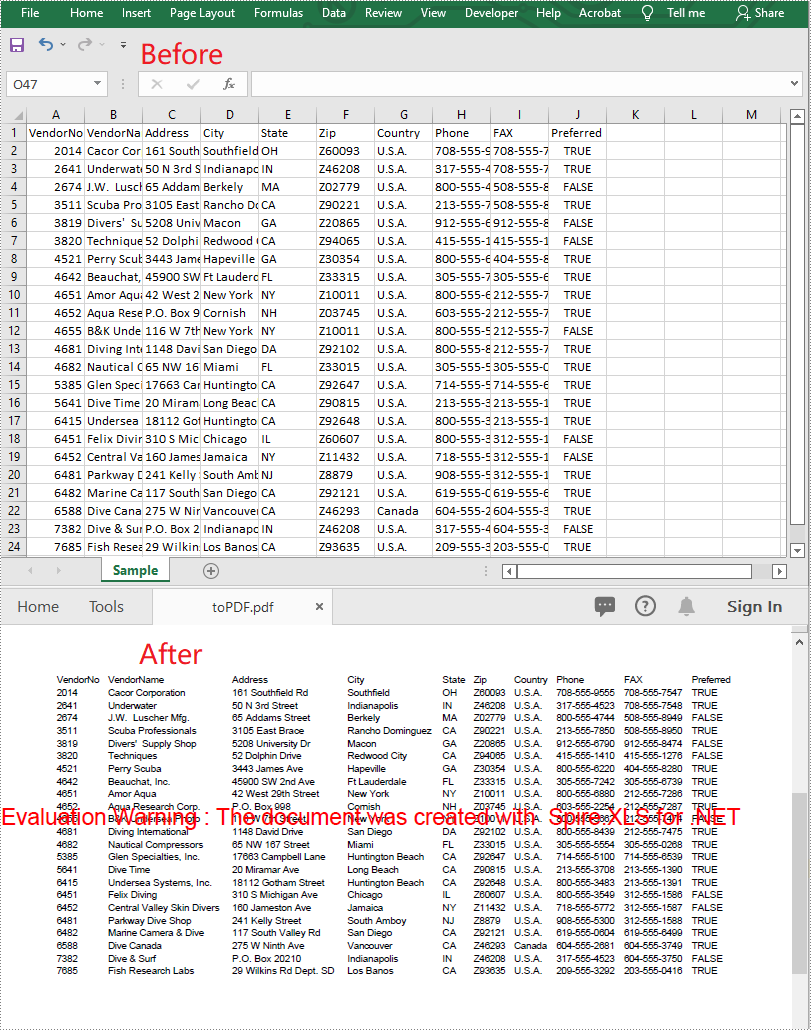
CSV is one of the commonly used file formats for exchanging tabular data between applications. However, in some circumstances, CSV may not be the most appropriate file format. For instance, if you have a CSV report that needs to be sent to an important customer, the best way to ensure the file appears as-is on the customer's device is to convert it to PDF. This article will demonstrate how to convert CSV to PDF in C# and VB.NET using Spire.XLS for .NET.
Install Spire.XLS for .NET
To begin with, you need to add the DLL files included in the Spire.XLS for .NET package as references in your .NET project. The DLL files can be either downloaded from this link or installed via NuGet.
PM> Install-Package Spire.XLS
Convert CSV to PDF in C# and VB.NET
The following are the steps to convert a CSV file to PDF:
- Create an instance of Workbook class.
- Load the CSV file using Workbook.LoadFromFile(filePath, separator) method.
- Set the Workbook.ConverterSetting.SheetFitToPage property as true to ensure the worksheet is rendered to one PDF page.
- Get the first worksheet in the Workbook using Workbook.Worksheets[0] property.
- Loop through the columns in the worksheet and auto-fit the width of each column using Worksheet.AutoFitColumn() method.
- Save the worksheet to PDF using Worksheet.SaveToPdf() method.
- C#
- VB.NET
using Spire.Xls;

namespace ConvertCsvToPdf
{
    class Program
    {
        static void Main(string[] args)
        {
            //Create a Workbook instance
            Workbook wb = new Workbook();
            //Load a CSV file
            wb.LoadFromFile("Sample.csv", ",");

            //Set SheetFitToPage property as true to ensure the worksheet is converted to 1 PDF page
            wb.ConverterSetting.SheetFitToPage = true;

            //Get the first worksheet
            Worksheet sheet = wb.Worksheets[0];

            //Loop through the columns in the worksheet
            for (int i = 1; i < sheet.Columns.Length; i++)
            {
                //AutoFit columns
                sheet.AutoFitColumn(i);
            }

            //Save the worksheet to PDF
            sheet.SaveToPdf("toPDF.pdf");
        }
    }
}
Apply for a Temporary License
If you'd like to remove the evaluation message from the generated documents, or to get rid of the function limitations, please request a 30-day trial license for yourself.
C#/VB.NET: Convert Excel to SVG
SVG, short for Scalable Vector Graphics, is a web-friendly vector image format. SVG has many advantages over other image formats. One of the most significant advantages is resolution independence, which means you can resize SVG images as needed without losing image quality. Sometimes, you may need to convert Excel files to SVG for web viewing. This article will demonstrate how to programmatically convert Excel to SVG in C# and VB.NET using Spire.XLS for .NET.
Install Spire.XLS for .NET
To begin with, you need to add the DLL files included in the Spire.XLS for .NET package as references in your .NET project. The DLL files can be either downloaded from this link or installed via NuGet.
PM> Install-Package Spire.XLS
Convert an Excel Worksheet to SVG using C# and VB.NET
Spire.XLS provides the Worksheet.SaveToSVGStream() method to convert an Excel worksheet to SVG. The detailed steps are as follows:
- Initialize an instance of the Workbook class.
- Load an Excel file using Workbook.LoadFromFile() method.
- Get a specific worksheet by its index through Workbook.Worksheets[int] property.
- Initialize an instance of the FileStream class.
- Save the worksheet to SVG using Worksheet.ToSVGStream(Stream, int, int, int, int) method.
- C#
- VB.NET
using Spire.Xls;
using System.IO;

namespace ConvertWorksheetToSVG
{
    class Program
    {
        static void Main(string[] args)
        {
            //Create an instance of Workbook class
            Workbook workbook = new Workbook();
            //Load an Excel file
            workbook.LoadFromFile("Sample1.xlsx");

            //Get the first worksheet
            Worksheet sheet = workbook.Worksheets[0];

            //Create an instance of FileStream class
            FileStream fs = new FileStream("E:\\Program Files\\WorksheetToSVG.svg", FileMode.Create);
            //Save the worksheet to SVG
            sheet.ToSVGStream(fs, 0, 0, 0, 0);
            fs.Flush();
            fs.Close();
        }
    }
}
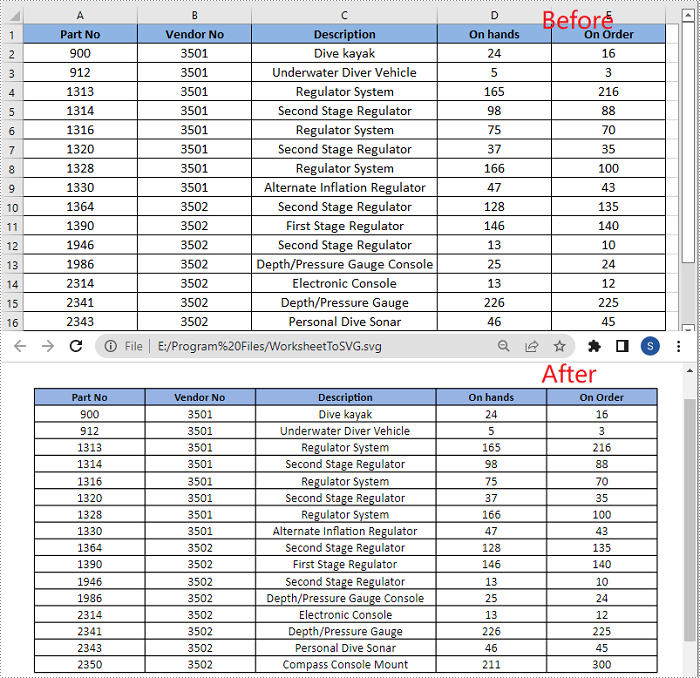
Convert an Excel Chart Sheet to SVG using C# and VB.NET
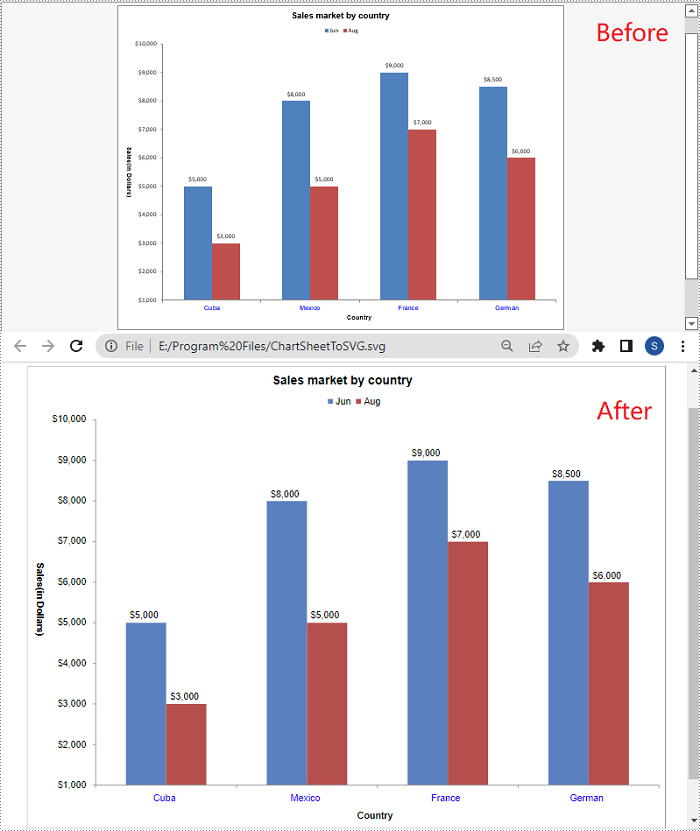
A chart sheet is a worksheet that only contains a chart. Spire.XLS allows you to convert a chart sheet to SVG by using the ChartSheet.ToSVGStream() method. The detailed steps are as follows:
- Initialize an instance of the Workbook class.
- Load an Excel file using Workbook.LoadFromFile() method.
- Get a specific chart sheet by its index through Workbook.Chartsheets[int] property.
- Initialize an instance of the FileStream class.
- Save the chart sheet to SVG using ChartSheet.ToSVGStream(Stream) method.
- C#
- VB.NET
using Spire.Xls;
using System.IO;

namespace ConvertChartSheetToSVG
{
    class Program
    {
        static void Main(string[] args)
        {
            //Create an instance of Workbook class
            Workbook workbook = new Workbook();
            //Load an Excel file
            workbook.LoadFromFile("Sample2.xlsx");

            //Get the first chart sheet
            ChartSheet chartSheet = workbook.Chartsheets[0];

            //Create an instance of FileStream class
            FileStream fs = new FileStream("E:\\ProgramFiles\\ChartSheetToSVG.svg", FileMode.Create);
            //Save the chart sheet to SVG
            chartSheet.ToSVGStream(fs);
            fs.Flush();
            fs.Close();
        }
    }
}
Apply for a Temporary License
If you'd like to remove the evaluation message from the generated documents, or to get rid of the function limitations, please request a 30-day trial license for yourself.
C#: Convert Excel to ODS or ODS to Excel
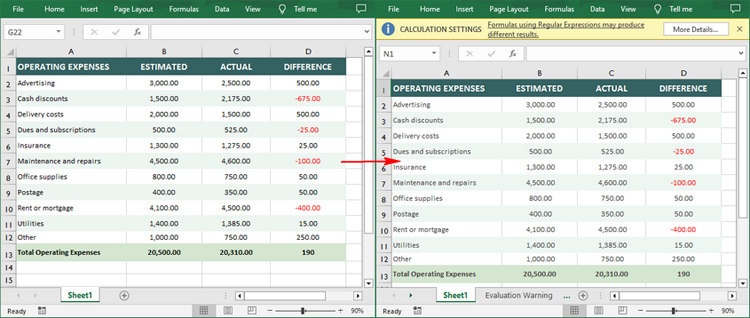
Excel, developed by Microsoft, is a widely used spreadsheet application that offers a range of features for data analysis, visualization, and management. ODS (OpenDocument Spreadsheet), on the other hand, is an open standard format for spreadsheets, which means it can be read and edited by various software applications, including LibreOffice and Apache OpenOffice.
Converting between these two formats can be necessary for compatibility, sharing, or specific feature requirements. In this article, you will learn how to convert Excel to ODS or OSD to Excel in C# using Spire.XLS for .NET.
Install Spire.XLS for .NET
To begin with, you need to add the DLL files included in the Spire.XLS for .NET package as references in your .NET project. The DLL files can be either downloaded from this link or installed via NuGet.
PM> Install-Package Spire.XLS
Convert Excel to ODS (OpenDocument Spreadsheet) in C#
You can load an Excel (.xls or .xlsx) file and then save it as an ODS file through the Workbook.SaveToFile(string fileName, FileFormat.ODS) method. The following are the detailed steps:
- Create a Workbook instance.
- Load an Excel file using Workbook.LoadFromFile() method.
- Save the Excel file to ODS format using Workbook.SaveToFile(string fileName, FileFormat.ODS) method.
- C#
using Spire.Xls;

namespace ConvertExcelToODS
{
    class Program
    {
        static void Main(string[] args)
        {
            // Create Workbook instance
            Workbook workbook = new Workbook();

            // Load an Excel file
            workbook.LoadFromFile("Sample.xlsx");

            // Save the Excel to ODS file
            workbook.SaveToFile("ToODS.ods", FileFormat.ODS);
        }
    }
}
Convert ODS to Excel (XLS/XLSX) in C#
Spire.XLS for .NET also supports converting an ODS file back to Excel XLS or XLS format. The following are the detailed steps:
- Create a Workbook instance.
- Load an ODS file using Workbook.LoadFromFile() method.
- Save the ODS file in XLS or XLSX format using Workbook.SaveToFile(string fileName, FileFormat fileFormat) method.
- C#
using Spire.Xls;

namespace ODSToExcel
{
    class Program
    {
        static void Main(string[] args)
        {
            // Create Workbook instance
            Workbook workbook = new Workbook();

            // Load an ODS file
            workbook.LoadFromFile("ToODS.ods");

            // Save the ODS file in XLSX format
            workbook.SaveToFile("ToExcel.xlsx", FileFormat.Version2016);

            // Save the ODS file in XLS format
            workbook.SaveToFile("ToExcel.xls", FileFormat.Version97to2003);
        }
    }
}

Apply for a Temporary License
If you'd like to remove the evaluation message from the generated documents, or to get rid of the function limitations, please request a 30-day trial license for yourself.
C#/VB.NET: Convert Excel Data to Word Tables with Formatting
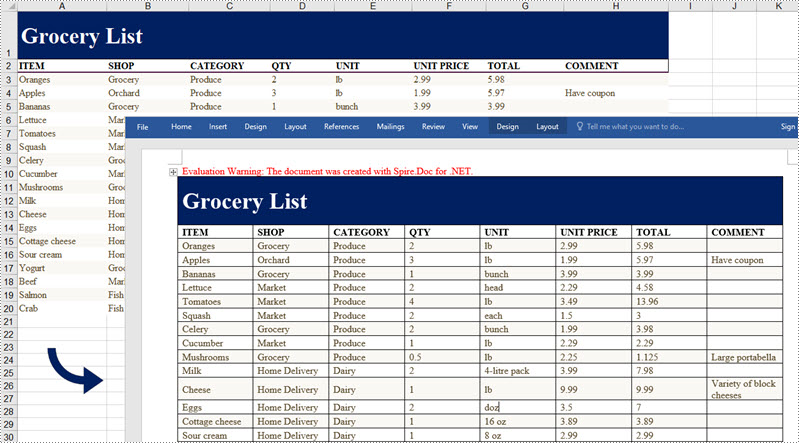
If you're creating a written report on a company's monthly expenditures, you might need to include a spreadsheet to show the financial figures and make them easier to read. This article demonstrates how to convert Excel data into a Word table maintaining the formatting in C# and VB.NET using Spire.Office for .NET.
Install Spire.Office for .NET
To begin with, you need to add the DLL files included in the Spire.Office for .NET package as references in your .NET project. The DLL files can be either downloaded from this link or installed via NuGet.
PM> Install-Package Spire.Office
Export Excel Data to a Word Table with Formatting
Below are the steps to convert Excel data to a Word table and keep the formatting using Spire.Office for .NET.
- Create a Workbook object and load a sample Excel file using Workbook.LoadFromFile() method.
- Get a specific worksheet through Workbook.Worksheets[index] property.
- Create a Document object, and add a section to it.
- Add a table using Section.AddTable() method.
- Detect the merged cells in the worksheet and merge the corresponding cells of the Word tale using the custom method MergeCells().
- Get value of a specific Excel cell through CellRange.Value property and add it to a cell of the Word table using TableCell.AddParagraph().AppendText() method.
- Copy the font style and cell style from Excel to the Word table using the custom method CopyStyle().
- Save the document to a Word file using Document.SaveToFile() method.
- C#
- VB.NET
using Spire.Doc;
using Spire.Doc.Documents;
using Spire.Doc.Fields;
using Spire.Xls;

namespace ConvertExcelToWord
{
    internal class Program
    {
        static void Main(string[] args)
        {

            //Load an Excel file
            Workbook workbook = new Workbook();
            workbook.LoadFromFile(@"C:\Users\Administrator\Desktop\sample.xlsx");

            //Get the first worksheet
            Worksheet sheet = workbook.Worksheets[0];

            //Create a Word document
            Document doc = new Document();
            Section section = doc.AddSection();
            section.PageSetup.Orientation = PageOrientation.Landscape;

            //Add a table
            Table table = section.AddTable(true);
            table.ResetCells(sheet.LastRow, sheet.LastColumn);

            //Merge cells
            MergeCells(sheet, table);

            for (int r = 1; r <= sheet.LastRow; r++)
            {
                //Set row Height
                table.Rows[r - 1].Height = (float)sheet.Rows[r - 1].RowHeight;

                for (int c = 1; c <= sheet.LastColumn; c++)
                {
                    CellRange xCell = sheet.Range[r, c];
                    TableCell wCell = table.Rows[r - 1].Cells[c - 1];

                    //Export data from Excel to Word table
                    TextRange textRange = wCell.AddParagraph().AppendText(xCell.NumberText);

                    //Copy font and cell style from Excel to Word
                    CopyStyle(textRange, xCell, wCell);
                }
            }

            //Save the document to a Word file
            doc.SaveToFile("ExportToWord.docx", Spire.Doc.FileFormat.Docx);
        }
        //Merge cells if any
        private static void MergeCells(Worksheet sheet, Table table)
        {
            if (sheet.HasMergedCells)
            {
                //Get merged cell ranges from Excel
                CellRange[] ranges = sheet.MergedCells;

                //Merge corresponding cells in Word table
                for (int i = 0; i < ranges.Length; i++)
                {
                    int startRow = ranges[i].Row;
                    int startColumn = ranges[i].Column;
                    int rowCount = ranges[i].RowCount;
                    int columnCount = ranges[i].ColumnCount;
                    if (rowCount > 1 && columnCount > 1)
                    {
                        for (int j = startRow; j <= startRow + rowCount; j++)
                        {
                            table.ApplyHorizontalMerge(j - 1, startColumn - 1, startColumn - 1 + columnCount - 1);
                        }
                        table.ApplyVerticalMerge(startColumn - 1, startRow - 1, startRow - 1 + rowCount - 1);
                    }
                    if (rowCount > 1 && columnCount == 1)
                    {
                        table.ApplyVerticalMerge(startColumn - 1, startRow - 1, startRow - 1 + rowCount - 1);
                    }
                    if (columnCount > 1 && rowCount == 1)
                    {
                        table.ApplyHorizontalMerge(startRow - 1, startColumn - 1, startColumn - 1 + columnCount - 1);
                    }
                }
            }
        }

        //Copy cell style of Excel to Word table
        private static void CopyStyle(TextRange wTextRange, CellRange xCell, TableCell wCell)
        {
            //Copy font style
            wTextRange.CharacterFormat.TextColor = xCell.Style.Font.Color;
            wTextRange.CharacterFormat.FontSize = (float)xCell.Style.Font.Size;
            wTextRange.CharacterFormat.FontName = xCell.Style.Font.FontName;
            wTextRange.CharacterFormat.Bold = xCell.Style.Font.IsBold;
            wTextRange.CharacterFormat.Italic = xCell.Style.Font.IsItalic;
            //Copy backcolor
            wCell.CellFormat.Shading.BackgroundPatternColor = xCell.Style.Color;
            //Copy horizontal alignment
            switch (xCell.HorizontalAlignment)
            {
                case HorizontalAlignType.Left:
                    wTextRange.OwnerParagraph.Format.HorizontalAlignment = HorizontalAlignment.Left;
                    break;
                case HorizontalAlignType.Center:
                    wTextRange.OwnerParagraph.Format.HorizontalAlignment = HorizontalAlignment.Center;
                    break;
                case HorizontalAlignType.Right:
                    wTextRange.OwnerParagraph.Format.HorizontalAlignment = HorizontalAlignment.Right;
                    break;
            }
            //Copy vertical alignment
            switch (xCell.VerticalAlignment)
            {
                case VerticalAlignType.Bottom:
                    wCell.CellFormat.VerticalAlignment = VerticalAlignment.Bottom;
                    break;
                case VerticalAlignType.Center:
                    wCell.CellFormat.VerticalAlignment = VerticalAlignment.Middle;
                    break;
                case VerticalAlignType.Top:
                    wCell.CellFormat.VerticalAlignment = VerticalAlignment.Top;
                    break;
            }
        }
    }
}
Apply for a Temporary License
If you'd like to remove the evaluation message from the generated documents, or to get rid of the function limitations, please request a 30-day trial license for yourself.
Convert worksheet to PDF in C#, VB.NET
We have discussed before about converting workbook to PDF. However, in this section, we will show you a neat solution to convert the specific worksheet to PDF with C# and VB.NET in workbook. Apply Spire.Xls for .NET in your application and you can turn worksheet into PDF easily without changing the layout of worksheet.
In the following sections, we will demonstrate how to convert worksheet to PDF.
Step 1: Initialize a new instance of Workbook class and load the sample Excel file.
Workbook workbook = new Workbook();
workbook.LoadFromFile("Sample.xlsx");
Step 2: Get its first worksheet.
Worksheet sheet = workbook.Worksheets[0];
Step 3: Convert the selected worksheet to PDF and save to file.
sheet.SaveToPdf("toPDF.pdf");
Step 4: Launch the file.
System.Diagnostics.Process.Start("toPDF.pdf");
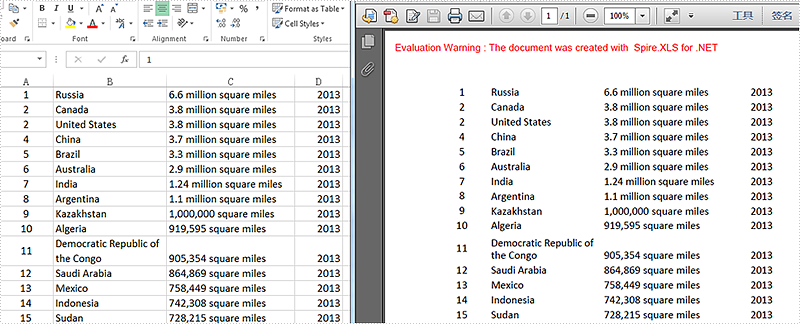
Effective screenshot:
Full codes:
using Spire.Xls;

namespace Excel_Worksheet_to_PDF
{
    class Program
    {
        static void Main(string[] args)
        {
            Workbook workbook = new Workbook();
            workbook.LoadFromFile("Sample.xlsx");

            Worksheet sheet = workbook.Worksheets[0];

            sheet.SaveToPdf("toPDF.pdf");
            System.Diagnostics.Process.Start("toPDF.pdf");
        }
    }
}
Imports Spire.Xls

Namespace Excel_Worksheet_to_PDF
	Class Program
		Private Shared Sub Main(args As String())
			Dim workbook As New Workbook()
			workbook.LoadFromFile("Sample.xlsx")

			Dim sheet As Worksheet = workbook.Worksheets(0)

			sheet.SaveToPdf("toPDF.pdf")
			System.Diagnostics.Process.Start("toPDF.pdf")
		End Sub
	End Class
End Namespace
Show formula and its result separately when converting excel to datatable in C#
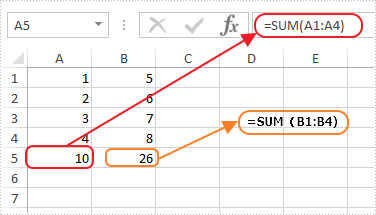
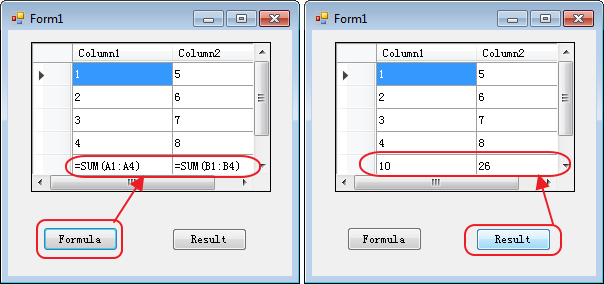
This article shows how to display formula and its result separately when converting excel to database via Spire.XLS. This demo uses an Excel file with formula in it and show the conversion result in a Windows Forms Application project.
Screenshot of the test excel file:
Here are the detailed steps:
Steps 1: Create a Windows Forms Application in Visual Studio.
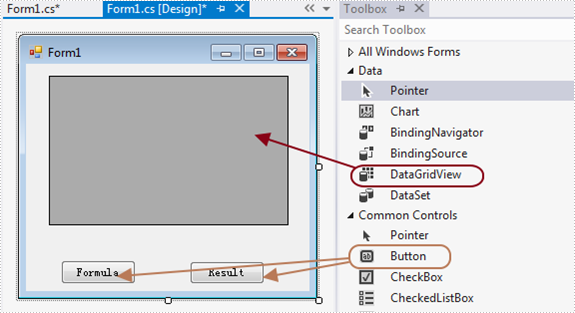
Steps 2: Drag a DataGridView and two Buttons from Toolbox to the Form and change names of the buttons as Formula and Result to distinguish.
Steps 3: Double click Button formula and add the following code.
3.1 Load test file and get the first sheet.
Workbook workbook = new Workbook();
workbook.LoadFromFile(@"1.xlsx");
Worksheet sheet = workbook.Worksheets[0];
3.2 Invoke method ExportDataTable of the sheet and output data range. Parameters of ExportDataTable are range to export, indicates if export column name and indicates whether compute formula value, then it will return exported datatable.
Description of ExportDataTable:
public DataTable ExportDataTable(CellRange range, bool exportColumnNames, bool computedFormulaValue);
Code:
DataTable dt = sheet.ExportDataTable(sheet.AllocatedRange, false, false);
3.3 Show in DataGridView
this.dataGridView1.DataSource = dt;
Steps 4: Do ditto to Button Result. Only alter parameter computedFormulaValue as true.
Workbook workbook = new Workbook();
workbook.LoadFromFile(@"1.xlsx");
Worksheet sheet = workbook.Worksheets[0];
DataTable dt = sheet.ExportDataTable(sheet.AllocatedRange, false, true);
this.dataGridView1.DataSource = dt;
Steps 5: Start the project and check the result.
Button code here:
//Formula
private void button1_Click(object sender, EventArgs e)
{
Workbook workbook = new Workbook();
workbook.LoadFromFile(@"1.xlsx");
Worksheet sheet = workbook.Worksheets[0];
DataTable dt = sheet.ExportDataTable(sheet.AllocatedRange, false, false);
this.dataGridView1.DataSource = dt;

}
//Result
private void button2_Click(object sender, EventArgs e)
{
Workbook workbook = new Workbook();
workbook.LoadFromFile(@"1.xlsx");
Worksheet sheet = workbook.Worksheets[0];
DataTable dt = sheet.ExportDataTable(sheet.AllocatedRange, false, true);
this.dataGridView1.DataSource = dt;
}
How to convert Excel worksheet to EMF image in C#
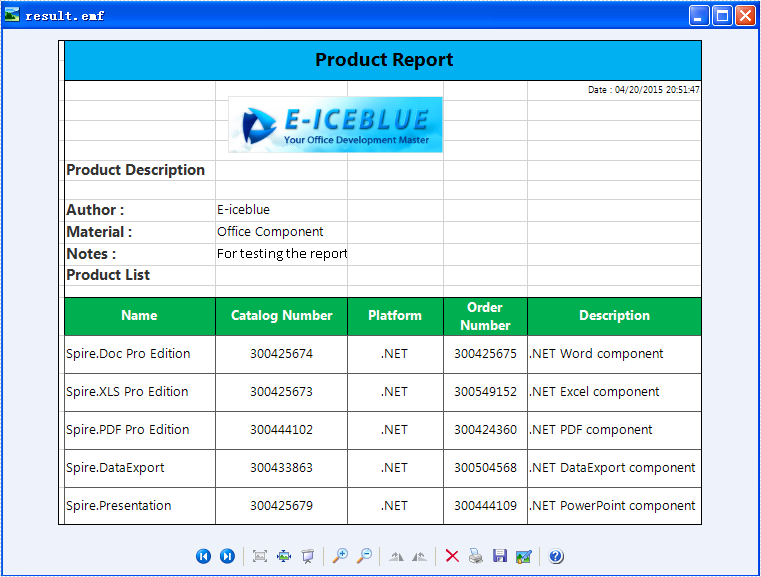
Spire.XLS has powerful functions to export Excel worksheets into different image file formats. In the previous articles, we have already shown you how to convert Excel worksheets into BMP, PNG, GIF, JPG, JPEG, TIFF. Now Spire.XLS newly starts to support exporting Excel worksheet into EMF image. With the help of Spire.XLS, you only need three lines of codes to finish the conversion function.
Make sure Spire.XLS (Version 7.6.43 or above) has been installed correctly and then add Spire.xls.dll as reference in the downloaded Bin folder though the below path: "..\Spire.Xls\Bin\NET4.0\ Spire. Xls.dll". Here comes to the details of how to convert excel worksheet to EMF image.
Step 1: Create an excel document and load the document from file.
Workbook workbook = new Workbook();
workbook.LoadFromFile("XLS2.xlsx");
Step 2: Get the first worksheet in excel workbook.
Worksheet sheet = workbook.Worksheets[0];
Step 3: Save excel worksheet into EMF image.
sheet.ToEMFStream(stream, 1, 1, 19, 6, EmfType.EmfPlusDual);
Effective screenshot:
Full codes:
using Spire.Xls;
using System.Drawing.Imaging;
using System.IO;

namespace XLStoEMF
{
    class Program
    {
        static void Main(string[] args)
        {
            Workbook workbook = new Workbook();
            workbook.LoadFromFile("XLS2.xlsx");

            Worksheet sheet = workbook.Worksheets[0];

            MemoryStream stream = new MemoryStream();
            sheet.ToEMFStream(stream, 1, 1, 19, 6, EmfType.EmfPlusDual);

            File.WriteAllBytes("result.emf", stream.ToArray());
        }
    }
}
How to Convert Selected Range of Cells to PDF in C#, VB.NET
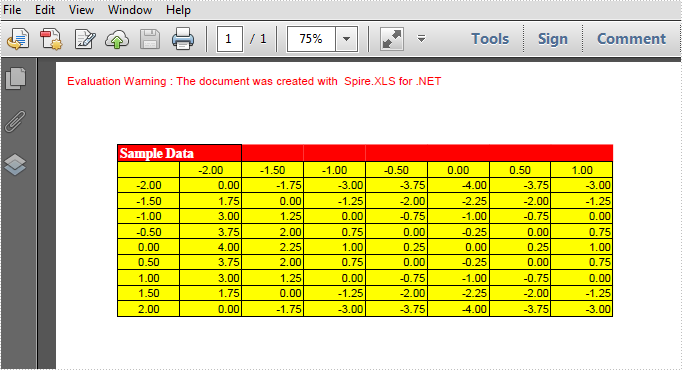
Using Spire.XLS, programmers are able to save the whole worksheet as PDF by calling the method SaveToPdf(). However, you may only want to save or export a part of worksheet as PDF. Since Spire.XLS doesn't provide a method to directly convert a range of cells to PDF, we can copy the selected ranges to a new worksheet and then save it as PDF file. This method seems complex, but it is still efficient with Spire.XLS.
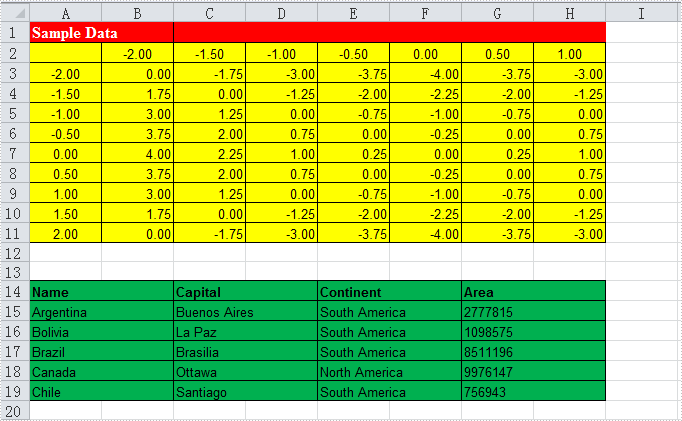
Look at the test file below, we only want the cells from A1 to H11 converted as PDF. We will firstly create a new blank worksheet, copy the selected range to the new sheet using CellRange.Copy() method, then convert the new sheet as PDF.
Code Snippet:
Step 1: Create a new workbook and load the test file.
Workbook workbook = new Workbook();
workbook.LoadFromFile("test.xlsx", ExcelVersion.Version2010);
Step 2: Add a new worksheet to workbook.
workbook.Worksheets.Add("newsheet");
Step 3: Copy the selected range from where it stores to the new worksheet.
workbook.Worksheets[0].Range["A1:H11"].Copy(workbook.Worksheets[1].Range["A1:H11"]);
Step 4: Convert the new worksheet to PDF.
workbook.Worksheets[1].SaveToPdf("result.pdf");
Result:
Full Code:
using Spire.Xls;
namespace Convert
{
    class Program
    {
        static void Main(string[] args)
        {
            Workbook workbook = new Workbook();
            workbook.LoadFromFile("test.xlsx", ExcelVersion.Version2010);
            // add a new sheet to workbook
            workbook.Worksheets.Add("newsheet");
            //Copy your area to new sheet.
            workbook.Worksheets[0].Range["A1:H11"].Copy(workbook.Worksheets[1].Range["A1:H11"]);
            //convert new sheet to pdf
            workbook.Worksheets[1].SaveToPdf("result.pdf");

        }
    }
}
Imports Spire.Xls
Namespace Convert
	Class Program
		Private Shared Sub Main(args As String())
			Dim workbook As New Workbook()
			workbook.LoadFromFile("test.xlsx", ExcelVersion.Version2010)
			' add a new sheet to workbook
			workbook.Worksheets.Add("newsheet")
			'Copy your area to new sheet.
			workbook.Worksheets(0).Range("A1:H11").Copy(workbook.Worksheets(1).Range("A1:H11"))
			'convert new sheet to pdf
			workbook.Worksheets(1).SaveToPdf("result.pdf")

		End Sub

	End Class
End Namespace