
Knowledgebase (2370)
Children categories
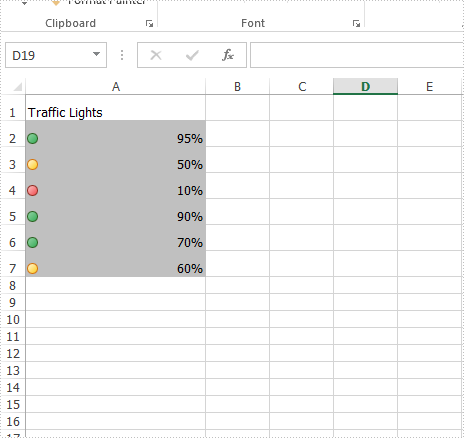
This article will demonstrate how to add the traffic lights icons in Java applications by using Spire.XLS for Java.
import com.spire.xls.*;
import com.spire.xls.core.IConditionalFormat;
import com.spire.xls.core.spreadsheet.collections.XlsConditionalFormats;

import java.awt.*;

public class setTrafficLightsIcons {
    public static void main(String[] args) {
        //Create a workbook
        Workbook workbook = new Workbook();

        //Add a worksheet
        Worksheet sheet = workbook.getWorksheets().get(0);

        //Add some data to the cell range and set the format for them
        sheet.getCellRange("A1").setText("Traffic Lights");
        sheet.getCellRange("A2").setNumberValue(0.95);
        sheet.getCellRange("A2").setNumberFormat("0%");
        sheet.getCellRange("A3").setNumberValue(0.5);
        sheet.getCellRange("A3").setNumberFormat("0%");
        sheet.getCellRange("A4").setNumberValue(0.1);
        sheet.getCellRange("A4").setNumberFormat("0%");
        sheet.getCellRange("A5").setNumberValue(0.9);
        sheet.getCellRange("A5").setNumberFormat("0%");
        sheet.getCellRange("A6").setNumberValue(0.7);
        sheet.getCellRange("A6").setNumberFormat("0%");
        sheet.getCellRange("A7").setNumberValue(0.6);
        sheet.getCellRange("A7").setNumberFormat("0%");

        //Set the height of row and width of column for Excel cell range
        sheet.getAllocatedRange().setRowHeight(20);
        sheet.getAllocatedRange().setColumnWidth(25);

        //Add a conditional formatting
        XlsConditionalFormats conditional = sheet.getConditionalFormats().add();
        conditional.addRange(sheet.getAllocatedRange());
        IConditionalFormat format1 = conditional.addCondition();

        //Add a conditional formatting of cell range and set its type to CellValue
        format1.setFormatType(ConditionalFormatType.CellValue);
        format1.setFirstFormula("300");
        format1.setOperator(ComparisonOperatorType.Less);
        format1.setFontColor(Color.black);
        format1.setBackColor(Color.lightGray);

        //Add a conditional formatting of cell range and set its type to IconSet
        conditional.addRange(sheet.getAllocatedRange());
        IConditionalFormat format = conditional.addCondition();
        format.setFormatType(ConditionalFormatType.IconSet);
        format.getIconSet().setIconSetType(IconSetType.ThreeTrafficLights1);

        //Save to file
        String result = "output/setTrafficLightsIcons_result.xlsx";
        workbook.saveToFile(result, ExcelVersion.Version2013);
    }
}
Effective screenshot of traffic lights icons on Excel worksheet:
Published in
Conditional Formatting
Tagged under
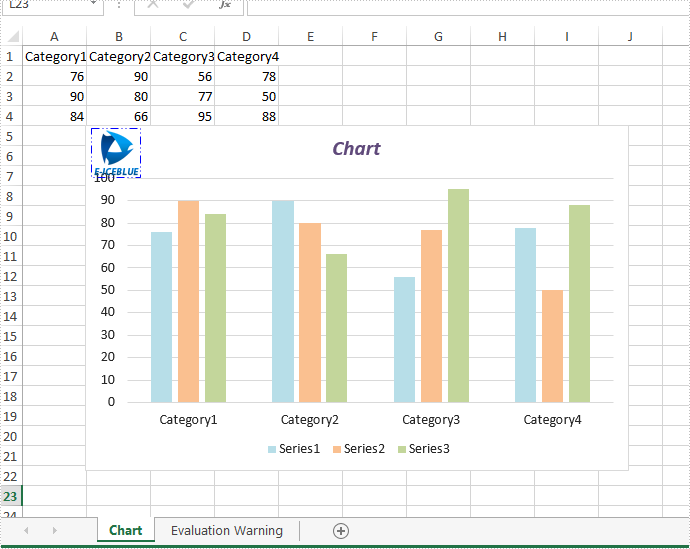
This article will introduce how to add a picture to Excel chart in java applications by using Spire.XLS for java.
import com.spire.xls.*;
import com.spire.xls.core.IPictureShape;
import com.spire.xls.core.IShape;
import java.awt.*;

public class addPictureToChart {
    public static void main(String[] args) {

        //Load the document from disk
        Workbook workbook = new Workbook();
        workbook.loadFromFile("Sample.xlsx");

        //get the first worksheet
        Worksheet sheet = workbook.getWorksheets().get(0);

        //get the first chart
        Chart chart = sheet.getCharts().get(0);

        //add the picture to chart and set its format
        IShape picture = chart.getShapes().addPicture("48.png");
        ((IPictureShape) picture).getLine().setDashStyle(ShapeDashLineStyleType.DashDotDot);
        ((IPictureShape) picture).getLine().setForeColor(Color.blue);

         //save the document
        String result = "output/AddPictureToChart.xlsx";
        workbook.saveToFile(result, ExcelVersion.Version2010);

    }
}
Effective screenshot after adding picture to Excel Chart:
Published in
Chart
Tagged under
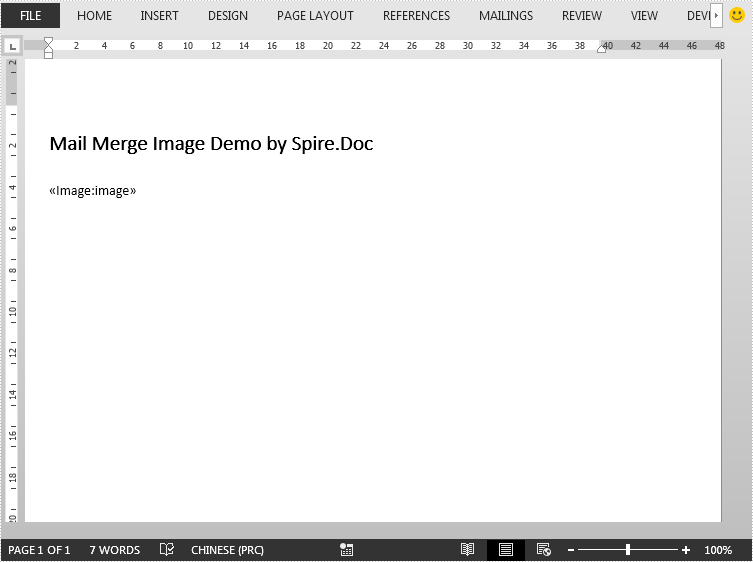
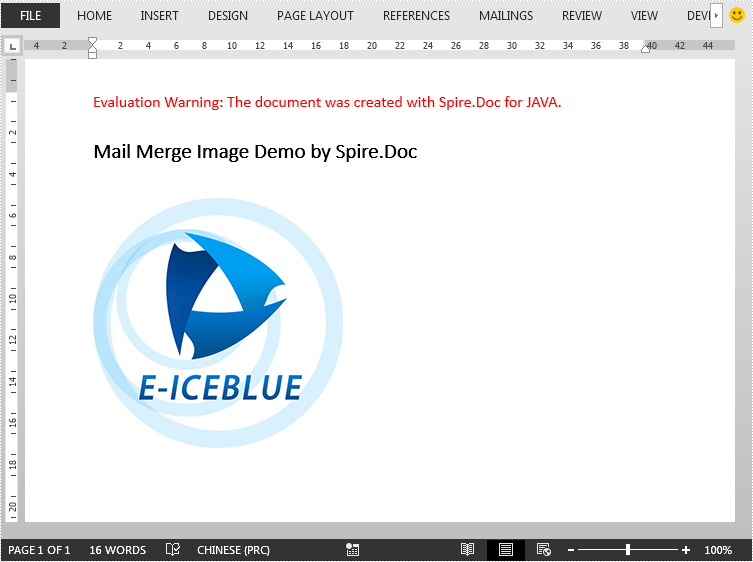
This article demonstrates how to mail merge image in Word document in Java using Spire.Doc for Java.
The template document:
import com.spire.doc.Document;
import com.spire.doc.FileFormat;
import com.spire.doc.reporting.MergeImageFieldEventArgs;
import com.spire.doc.reporting.MergeImageFieldEventHandler;

import java.text.SimpleDateFormat;
import java.util.Date;

public class SimpleMailMerge {
    public static void main(String[] args) throws Exception {
        //create a Document instance
        Document document = new Document();
        //load the template document
        document.loadFromFile("template - Copy.docx");

        //specify the merge field name
        String[] filedNames = new String[]{"image"};
        //specify the path of image
        String[] filedValues = new String[]{"logo.png"};
        //invoke the mail merge event to load image
        document.getMailMerge().MergeImageField = new MergeImageFieldEventHandler() {
            public void invoke(Object sender, MergeImageFieldEventArgs args) {
                mailMerge_MergeImageField(sender, args);
            }
        };
        //execute mail merge
        document.getMailMerge().execute(filedNames, filedValues);

        //save file
        document.saveToFile("MailMergeImage.docx", FileFormat.Docx_2013);
    }
    //create a mail merge event to load image
    private static void mailMerge_MergeImageField(Object sender, MergeImageFieldEventArgs field) {
        String filePath = field.getImageFileName();
        if (filePath != null && !"".equals(filePath)) {
            try {
                field.setImage(filePath);
            } catch (Exception e) {
                e.printStackTrace();
            }
        }
    }
}
The output document:
Published in
Mail Merge
Tagged under
