
Knowledgebase (2370)
Children categories
Edit PDF Using Python: A Practical Guide to PDF Modification
2025-05-06 03:42:04 Written by Administrator
PDFs are widely used in reports, invoices, and digital forms due to their consistent formatting across platforms. However, their fixed layout makes editing difficult without specialized tools. For developers looking to edit PDF using Python, Spire.PDF for Python provides a comprehensive and easy-to-use solution. This Python PDF editor enables you to modify PDF files programmatically—changing text, replacing images, adding annotations, handling forms, and securing files—without relying on Adobe Acrobat or any external software.
In this article, we will explore how to use Spire.PDF for Python to programmatically edit PDFs in Python applications.
- Why Use Python and Spire.PDF to Edit PDF Documents?
- Getting Started with Spire.PDF for Python
- How to Edit an Existing PDF Using Spire.PDF for Python
- Frequently Asked Questions
Why Use Python and Spire.PDF to Edit PDF Documents?
Python is a highly versatile programming language that provides an excellent platform for automating and managing PDF documents. When it comes to edit PDF Python tasks, Spire.PDF for Python stands out as a comprehensive and easy-to-use solution for all your PDF manipulation needs.
Benefits of Using Python for PDF Editing
- Automation and Batch Processing: Streamline repetitive PDF editing tasks efficiently.
- Cost-Effective: Reduce manual work, saving time and resources when you Python-edit PDF files.
- Integration: Seamlessly incorporate PDF editing into existing Python-based systems and workflows.
Advantages of Spire.PDF for Python
Spire.PDF for Python is a standalone library that enables developers to create, read, edit, convert, and save PDF files without relying on external software. As a trusted Python PDF editor, it offers powerful features such as:
- Text and Image Editing
- Annotations and Bookmark Management
- Form Field Handling
- Security Settings (Encryption and Permissions)
- Conversion to Word, Excel, HTML, and Images
To learn more about these specific features, visit the Spire.PDF for Python tutorials.
With its intuitive API design, Spire.PDF makes it easier than ever to edit PDF files in Python quickly and effectively, ensuring a smooth development experience.
Getting Started with Spire.PDF for Python
Installation:
To install Spire.PDF for Python, simply run the following pip command:
pip install spire.pdf
Alternatively, you can install Free Spire.PDF for Python, a free version suitable for small projects, by running:
pip install spire.pdf.free
You can also download the library manually from the links.
Basic Setup Example:
The following example demonstrates how to create a simple PDF using Spire.PDF for Python:
- Python
from spire.pdf import PdfDocument, PdfFont, PdfBrushes, PdfFontFamily, PdfFontStyle

# Create a new PDF document
pdf = PdfDocument()
# Add a new page to the document
page = pdf.Pages.Add()
# Create a font
font = PdfFont(PdfFontFamily.TimesRoman, 28.0, PdfFontStyle.Bold)
# Create a brush
brush = PdfBrushes.get_Black()
# Draw the string using the font and brush
page.Canvas.DrawString("Hello, World", font, brush, 100.0, 100.0)
# Save the document
pdf.SaveToFile("output/NewPDF.pdf")
pdf.Close()
Result: The generated PDF displays the text "Hello, World" using Times Roman Bold.

With Spire.PDF installed, you're now ready to edit PDFs using Python. The sections below explain how to manipulate structure, content, security, and metadata.
How to Edit an Existing PDF Using Spire.PDF for Python
Spire.PDF for Python provides a simple yet powerful way to edit PDF using Python. With its intuitive API, developers can automate a wide range of PDF editing tasks including modifying document structure, page content, security settings, and properties. This section outlines the core categories of editing and their typical use cases.
Edit PDF Pages and Structure with Python
Structure editing lets you manipulate PDF page order, merge files, or insert/delete pages—ideal for document assembly workflows.
- Insert or Delete Pages
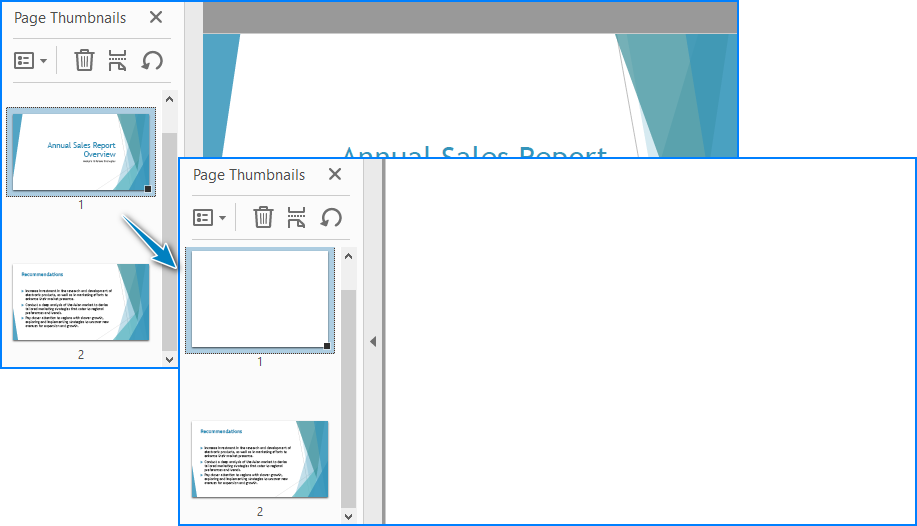
Use the Pages.Insert() and Pages.RemoveAt() methods of the PdfDocument class to insert or delete pages at specific positions.
Code Example
- Python
from spire.pdf import PdfDocument, PdfPageSize, PdfMargins, PdfPageRotateAngle

# Load a PDF document
pdf = PdfDocument()
pdf.LoadFromFile("Sample.pdf")

# Insert and delete pages
# Insert at beginning
pdf.Pages.Insert(0, PdfPageSize.A4(), PdfMargins(50.0, 60.0), PdfPageRotateAngle.RotateAngle90)
# Delete second page
pdf.Pages.RemoveAt(1)

# Save the document
pdf.SaveToFile("output/InsertDeletePage.pdf")
pdf.Close()
Result:
- Merge Two PDF Files
The AppendPage() method allows you to combine PDFs by inserting pages from one document into another.
Code Example
- Python
import os
from spire.pdf import PdfDocument

# Specify the PDF file path
pdfPath = "PDFs/"
# Read the PDF file names from the path and add them to a list
files = [pdfPath + file for file in os.listdir(pdfPath) if file.endswith(".pdf")]

# Load the first PDF file
pdf = PdfDocument()
pdf.LoadFromFile(files[0])
# Iterate through the other PDF files
for i in range(1, len(files)):
    # Load the current PDF file
    pdf2 = PdfDocument()
    pdf2.LoadFromFile(files[i])
    # Append the pages from the current PDF file to the first PDF file
    pdf.AppendPage(pdf2)

# Save the merged PDF file
pdf.SaveToFile("output/MergePDFs.pdf")
pdf.Close()
Result:

You may also like: Splitting PDF Files with Python Code
Edit PDF Content with Python
As a Python PDF editor, Spire.PDF supports a variety of content-level operations, including modifying text, images, annotations, and interactive forms.
- Replace Text in a PDF
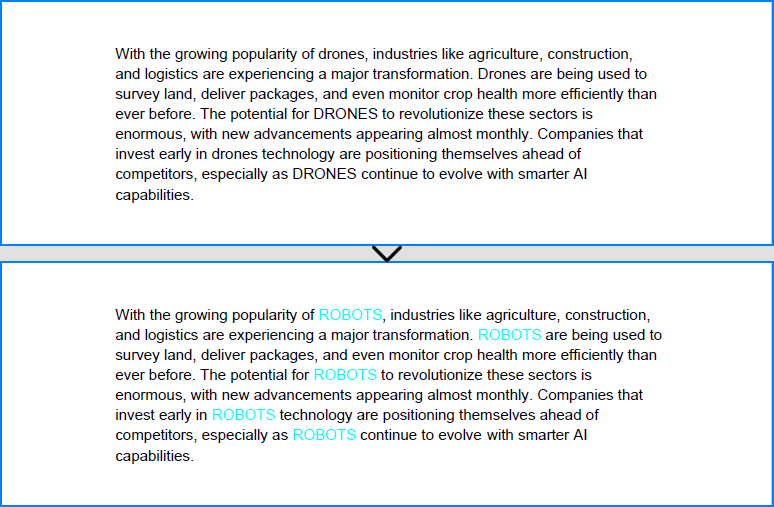
The PdfTextReplacer class can be used to find and replace text from a page. Note that precise replacement may require case and layout-aware handling.
Code Example
- Python
from spire.pdf import PdfDocument, PdfTextReplacer, ReplaceActionType, Color

# Load the PDF file
pdf = PdfDocument()
pdf.LoadFromFile("Sample.pdf")

# Iterate through the pages
for i in range(pdf.Pages.Count):
    page = pdf.Pages.get_Item(i)
    # Create a PdfTextReplacer object
    replacer = PdfTextReplacer(page)
    # Set the replacement options
    replacer.Options.ReplaceType = ReplaceActionType.IgnoreCase
    # Replace the text
    replacer.ReplaceAllText("drones", "ROBOTS", Color.get_Aqua()) # Setting the color is optional

# Save the merged PDF file
pdf.SaveToFile("output/ReplaceText.pdf")
pdf.Close()
Result:
- Replace Images in a PDF
Spire.PDF for Python provides the PdfImageHelper class to help you replace images in a PDF file with ease. By retrieving image information from a specific page, you can use the ReplaceImage() method to directly substitute the original image with a new one.
Code Example
- Python
from spire.pdf import PdfDocument, PdfImageHelper, PdfImage

# Load the PDF file
pdf = PdfDocument()
pdf.LoadFromFile("Sample.pdf")

# Get a page
page = pdf.Pages.get_Item(0)

# Create a PdfImageHelper instance
imageHelper = PdfImageHelper()
# Get the image info of the first image on the page
imageInfo = imageHelper.GetImagesInfo(page)[0]
# Load a new image
newImage = PdfImage.FromFile("Image.png")
# Replace the image
imageHelper.ReplaceImage(imageInfo, newImage)

# Save the PDF file
pdf.SaveToFile("output/ReplaceImage.pdf")
pdf.Close()
Result:

- Add Comments or Notes
To add comments or notes with Python, use the PdfTextMarkupAnnotation class and add it to the page’s AnnotationsWidget collection.
Code Example
- Python
from spire.pdf import PdfDocument, PdfTextFinder, PdfTextMarkupAnnotation, PdfRGBColor, Color

# Load the PDF file
pdf = PdfDocument()
pdf.LoadFromFile("Sample.pdf")

# Get a page
page = pdf.Pages.get_Item(0)

#Create a PdfTextFinder instance and set the options
finder = PdfTextFinder(page)
finder.Options.Parameter.IgnoreCase = False
finder.Options.Parameter.WholeWord = True
# Find the text to comment
text = finder.Find("redefining entire industries")[0]

# Get the bound of the text
bound = text.Bounds[0]

# Add comment
commentText = ("This is a powerful expression, but a bit vague. "
                "You might consider specifying which industries are "
                "being redefined and how, to make the claim more "
                "concrete and credible.")
comment = PdfTextMarkupAnnotation("Commenter", commentText, bound)
comment.TextMarkupColor = PdfRGBColor(Color.get_Yellow())
page.AnnotationsWidget.Add(comment)

# Save the PDF file
pdf.SaveToFile("output/CommentNote.pdf")
pdf.Close()
Result:

- Edit or Read Form Fields
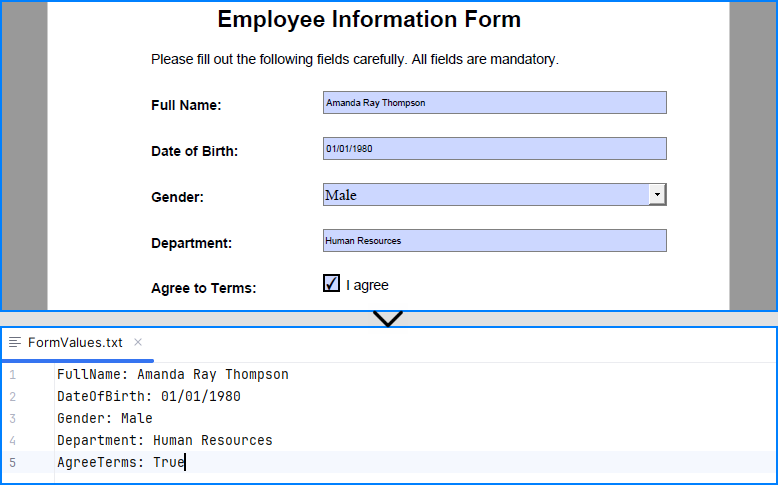
Spire.PDF for Python allows you to programmatically fill out and read form fields in a PDF document. By accessing the FieldsWidget property of a PdfFormWidget object, you can iterate through all interactive form elements, such as text boxes, combo boxes, and checkboxes, and update or extract their values.
Code Example
- Python
from spire.pdf import PdfDocument, PdfFormWidget, PdfComboBoxWidgetFieldWidget, PdfCheckBoxWidgetFieldWidget, PdfTextBoxFieldWidget

# Load the PDF file
pdf = PdfDocument()
pdf.LoadFromFile("EmployeeInformationForm.pdf")

forms = pdf.Form
formWidgets = PdfFormWidget(forms).FieldsWidget

# Fill the forms
for i in range(formWidgets.Count):
    formField = formWidgets.get_Item(i)
    if formField.Name == "FullName":
        textBox = PdfTextBoxFieldWidget(formField)
        textBox.Text = "Amanda Ray Thompson"
    elif formField.Name == "DateOfBirth":
        textBox = PdfTextBoxFieldWidget(formField)
        textBox.Text = "01/01/1980"
    elif formField.Name == "Gender":
        comboBox = PdfComboBoxWidgetFieldWidget(formField)
        comboBox.SelectedIndex  = [ 1 ]
    elif formField.Name == "Department":
        formField.Value = "Human Resources"
    elif formField.Name == "AgreeTerms":
        checkBox = PdfCheckBoxWidgetFieldWidget(formField)
        checkBox.Checked = True

# Read the forms
formValues = []

for i in range(formWidgets.Count):
    formField = formWidgets.get_Item(i)
    if isinstance(formField, PdfTextBoxFieldWidget):
        formValues.append(formField.Name + ": " + formField.Text)
    elif isinstance(formField, PdfComboBoxWidgetFieldWidget):
        formValues.append(formField.Name + ": " + formField.SelectedValue)
    elif isinstance(formField, PdfCheckBoxWidgetFieldWidget):
        formValues.append(formField.Name + ": " + str(formField.Checked))

# Write the form values to a file
with open("output/FormValues.txt", "w") as file:
    file.write("\n".join(formValues))

# Save the PDF file
pdf.SaveToFile("output/FilledForm.pdf")
pdf.Close()
Result:
Explore more: How to Insert Page Numbers to PDF Using Python
Manage PDF Security with Python
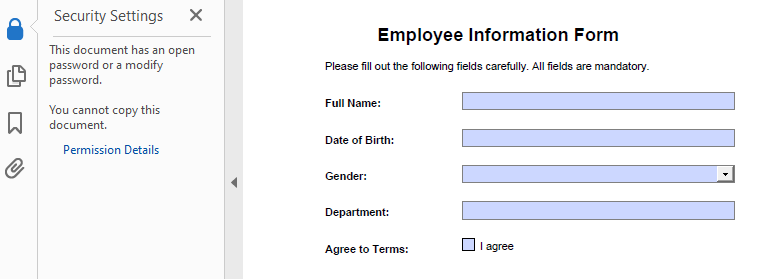
PDF security editing is essential when dealing with sensitive documents. Spire.PDF supports encryption, password protection, digital signature handling, and permission settings.
- Add a Password and Set Permissions
The Encrypt() method lets you secure a PDF with user/owner passwords and define allowed actions like printing or copying.
Code Example
- Python
from spire.pdf import PdfDocument, PdfEncryptionAlgorithm, PdfDocumentPrivilege, PdfPasswordSecurityPolicy

# Load the PDF file
pdf = PdfDocument()
pdf.LoadFromFile("EmployeeInformationForm.pdf")

# Create a PdfSecurityPolicy object and set the passwords and encryption algorithm
securityPolicy = PdfPasswordSecurityPolicy("userPSD", "ownerPSD")
securityPolicy.EncryptionAlgorithm = PdfEncryptionAlgorithm.AES_128

# Set the document privileges
pdfPrivileges = PdfDocumentPrivilege.ForbidAll()
pdfPrivileges.AllowPrint = True
pdfPrivileges.AllowFillFormFields  = True
# Apply the document privileges
securityPolicy.DocumentPrivilege = pdfPrivileges

# Encrypt the PDF with the security policy
pdf.Encrypt(securityPolicy)

# Save the PDF file
pdf.SaveToFile("output/EncryptedForm.pdf")
pdf.Close()
Result
- Remove the Password from a PDF
To open a protected file, provide the user password when calling LoadFromFile(), use Decrypt() to decrypt the document, and save it again unprotected.
Code Example
- Python
from spire.pdf import PdfDocument

# Load the encrypted PDF file with the owner password
pdf = PdfDocument()
pdf.LoadFromFile("output/EncryptedForm.pdf", "ownerPSD")

# Decrypt the PDF file
pdf.Decrypt()

# Save the PDF file
pdf.SaveToFile("output/DecryptedForm.pdf")
pdf.Close()
Recommended for you: Use Python to Add and Remove Digital Signature in PDF
Edit PDF Properties with Python
Use Spire.PDF to read and edit PDF metadata and viewer preferences—key features for document presentation and organization.
- Update Document Metadata
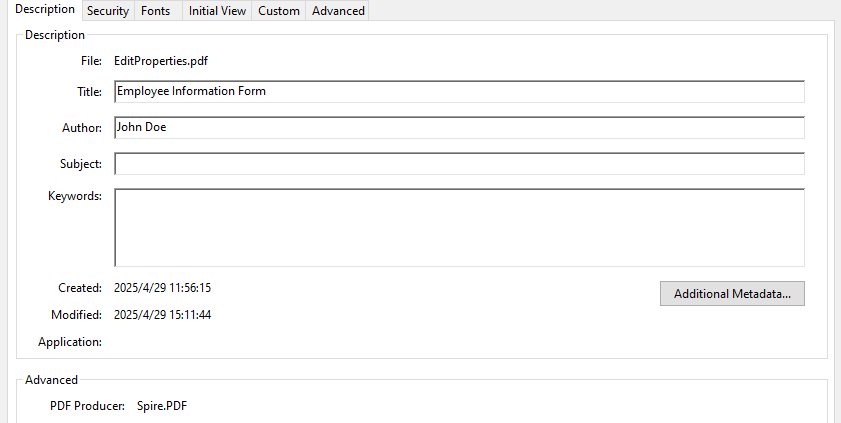
Update metadata such as title, author, or subject via the DocumentInformation property of the PDF document.
Code Example
- Python
from spire.pdf import PdfDocument

# Load the PDF file
pdf = PdfDocument()
pdf.LoadFromFile("EmployeeInformationForm.pdf")

# Set document metadata
pdf.DocumentInformation.Author = "John Doe"
pdf.DocumentInformation.Title = "Employee Information Form"
pdf.DocumentInformation.Producer  = "Spire.PDF"

# Save the PDF file
pdf.SaveToFile("output/EditProperties.pdf")
pdf.Close()
Result:
- Set View Preferences
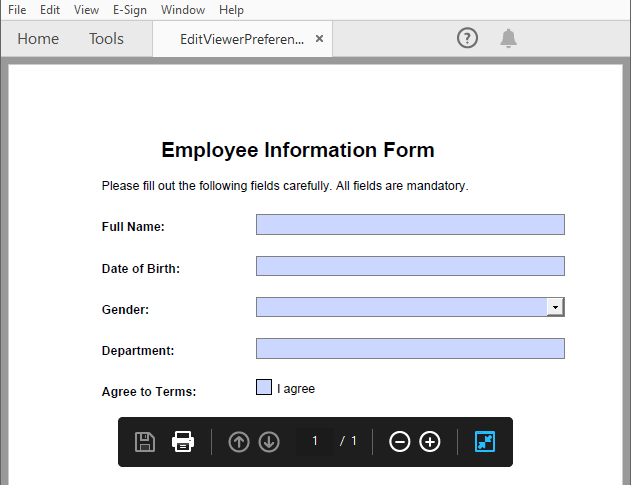
The ViewerPreferences property allows you to customize the viewing mode of a PDF (e.g., two-column layout).
Code Example
- Python
from spire.pdf import PdfDocument, PdfPageLayout, PrintScalingMode

# Load the PDF file
pdf = PdfDocument()
pdf.LoadFromFile("EmployeeInformationForm.pdf")

# Set the viewer preferences
pdf.ViewerPreferences.DisplayTitle = True
pdf.ViewerPreferences.HideToolbar = True
pdf.ViewerPreferences.HideWindowUI = True
pdf.ViewerPreferences.FitWindow = False
pdf.ViewerPreferences.HideMenubar = True
pdf.ViewerPreferences.PrintScaling = PrintScalingMode.AppDefault
pdf.ViewerPreferences.PageLayout = PdfPageLayout.OneColumn

# Save the PDF file
pdf.SaveToFile("output/EditViewerPreference.pdf")
pdf.Close()
Result:
Similar topic: Change PDF Version Easily with Python Code
Conclusion
Editing PDFs using Python is both practical and efficient with Spire.PDF for Python. Whether you're building automation tools, editing digital forms, or securing sensitive reports, Spire.PDF equips you with a comprehensive suite of editing features—all accessible via clean and simple Python code.
With capabilities that span content editing, form interaction, document structuring, and security control, this Python PDF editor is a go-to solution for developers and organizations aiming to streamline their PDF workflows.
Frequently Asked Questions
Q: Can I edit a PDF using Python?
A: Yes, Python offers powerful libraries like Spire.PDF for Python that enable you to edit text, images, forms, annotations, and even security settings in a PDF file.
Q: How to edit a PDF using coding?
A: By using libraries such as Spire.PDF for Python, you can load an existing PDF, modify its content or structure programmatically, and save the changes with just a few lines of code.
Q: What is the Python library for PDF editor?
A: Spire.PDF for Python is a popular choice. It offers comprehensive functionalities for creating, reading, editing, converting, and securing PDF documents without the need for additional software.
Q: Can I modify a PDF for free?
A: Yes, you can use the free edition of Spire.PDF for Python to edit PDF files, although it comes with some limitations, such as processing up to 10 pages per document. Additionally, you can apply for a 30-day temporary license that removes all limitations and watermarks for full functionality testing.
PDF documents may occasionally include blank pages. These pages can affect the reading experience, increase the file size and lead to paper waste during printing. To improve the professionalism and usability of a PDF document, detecting and removing blank pages is an essential step.
This article shows how to accurately detect and remove blank pages—including those that appear empty but actually contain invisible elements—using Python, Spire.PDF for Python, and Pillow.
Install Required Libraries
This tutorial requires two Python libraries:
- Spire.PDF for Python: Used for loading PDFs and detecting/removing blank pages.
- Pillow: A library for image processing that helps detect visually blank pages, which may contain invisible content.
You can easily install both libraries using pip:
pip install Spire.PDF Pillow
Need help installing Spire.PDF? Refer to this guide:
How to Install Spire.PDF for Python on Windows
How to Effectively Detect and Remove Blank Pages from PDF Files in Python
Spire.PDF provides a method called PdfPageBase.IsBlank() to check if a page is completely empty. However, some pages may appear blank but actually contain hidden content like white text, watermarks, or background images. These cannot be reliably detected using the PdfPageBase.IsBlank() method alone.
To ensure accuracy, this tutorial adopts a two-step detection strategy:
- Use the PdfPageBase.IsBlank() method to identify and remove fully blank pages.
- Convert non-blank pages to images and analyze them using Pillow to determine if they are visually blank.
⚠️ Important:
If you don’t use a valid license during the PDF-to-image conversion, an evaluation watermark will appear on the image, potentially affecting the blank page detection.
Contact the E-iceblue sales team to request a temporary license for proper functionality.
Steps to Detect and Remove Blank Pages from PDF in Python
Follow these steps to implement blank page detection and removal in Python:
1. Define a custom is_blank_image() Method
This custom function uses Pillow to check whether the converted image of a PDF page is blank (i.e., if all pixels are white).
2. Load the PDF Document
Load the PDF using the PdfDocument.LoadFromFile() method.
3. Iterate Through Pages
Loop through each page to check if it’s blank using two methods:
- If the PdfPageBase.IsBlank() method returns True, remove the page directly.
- If not, convert the page to an image using the PdfDocument.SaveAsImage() method and analyze it with the custom is_blank_image() method.
4. Save the Result PDF
Finally, save the PDF with blank pages removed using the PdfDocument.SaveToFile() method.
Code Example
- Python
import io
from spire.pdf import PdfDocument
from PIL import Image

# Custom function: Check if the image is blank (whether all pixels are white)
def is_blank_image(image):
        # Convert to RGB mode and then get the pixels
        img = image.convert("RGB")
        # Get all pixel points and check if they are all white
        white_pixel = (255, 255, 255)
        return all(pixel == white_pixel for pixel in img.getdata())

# Load the PDF document
pdf = PdfDocument()
pdf.LoadFromFile("Sample1111.pdf")

# Iterate through each page in reverse order to avoid index issues when deleting
for i in range(pdf.Pages.Count - 1, -1, -1):
    page = pdf.Pages.get_Item(i)
    # Check if the current page is completely blank
    if page.IsBlank():
        # If it's completely blank, remove it directly from the document
        pdf.Pages.RemoveAt(i)
    else:
        # Convert the current page to an image
        with pdf.SaveAsImage(i) as image_data:
            image_bytes = image_data.ToArray()
            pil_image = Image.open(io.BytesIO(image_bytes))
            # Check if the image is blank
            if is_blank_image(pil_image):
                # If it's a blank image, remove the corresponding page from the document
                pdf.Pages.RemoveAt(i)

# Save the resulting PDF
pdf.SaveToFile("RemoveBlankPages.pdf")
pdf.Close()

Frequently Asked Questions (FAQs)
Q1: What is considered a blank page in a PDF file?
A: A blank page may be truly empty or contain hidden elements such as white text, watermarks, or transparent objects. This solution detects both types using a dual-check strategy.
Q2: Can I use this method without a Spire.PDF license?
A: Yes, you can run it without a license. However, during PDF-to-image conversion, an evaluation watermark will be added to the output images, which may affect the accuracy of blank page detection. It's best to request a free temporary license for testing.
Q3: What versions of Python are compatible with Spire.PDF?
A: Spire.PDF for Python supports Python 3.7 and above. Ensure that Pillow is also installed to perform image-based blank page detection.
Q4: Can I modify the script to only detect blank pages without deleting them?
A: Absolutely. Just remove or comment out the pdf.Pages.RemoveAt(i) line and use print() or logging to list detected blank pages for further review.
Conclusion
Removing unnecessary blank pages from PDF files is an important step in optimizing documents for readability, file size, and professional presentation. With the combined power of Spire.PDF for Python and Pillow, developers can precisely identify both completely blank pages and pages that appear empty but contain invisible content. Whether you're generating reports, cleaning scanned files, or preparing documents for print, this Python-based solution ensures clean and efficient PDFs.
Get a Free License
To fully experience the capabilities of Spire.PDF for Python without any evaluation limitations, you can request a free 30-day trial license.
Generating Word documents programmatically is a common requirement in business applications, whether for creating reports, contracts, or personalized letters. Spire.Doc for .NET provides a comprehensive solution for working with Word documents in C# without Microsoft Office dependencies.
This article explores two effective approaches for document generation from templates: replacing text placeholders and modifying bookmark content.
- Create a Word Document By Replacing Text Placeholders
- Create a Word Document By Replacing Bookmark Content
.NET Library for Creating Word Documents
Spire.Doc for .NET is a professional Word API that enables developers to perform a wide range of document processing tasks. Key features include:
- Creating, reading, editing, and converting Word documents
- Support for DOC, DOCX, RTF, and other formats
- Template-based document generation
- Mail merge functionality
- Preservation of original formatting
The library is particularly useful for automating document generation in enterprise applications, where consistency and efficiency are crucial.
To begin generating Word documents from a template, donwload Spire.Doc for .NET from our official website or install it using the NuGet Package Manager with the following command:
PM> Install-Package Spire.Doc
Create a Word Document By Replacing Text Placeholders
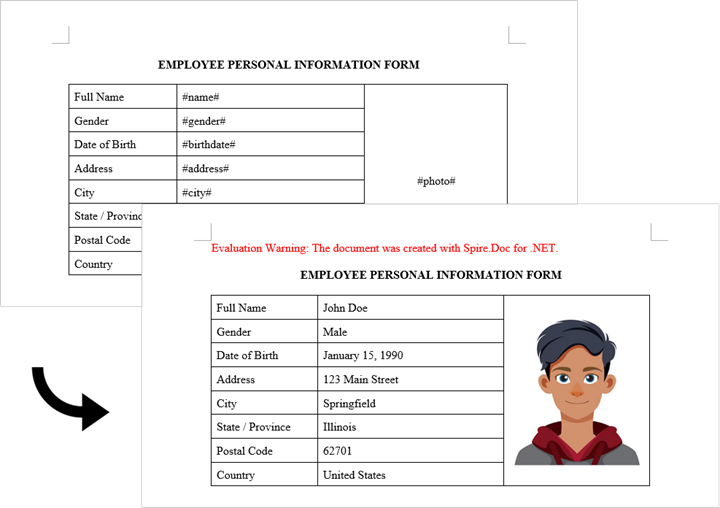
The Document.Replace method in the Spire.Doc library is used to find and replace specific text within a Word document. This method allows for the efficient modification of text placeholders, enabling the dynamic generation of documents based on templates.
Here are the steps for Word generation through text pattern replacement:
- Document Initialization: Create a new Document object and load the template file.
- Placeholder Definition: Use a dictionary to map placeholders (like #name#) to their replacement values.
- Text Replacement: The Document.Replace method performs case-sensitive and whole-word replacement of all placeholders.
- Image Handling: The custom ReplaceTextWithImage method locates a text placeholder and substitutes it with an image.
- Document Saving: The modified document is saved with a new filename.
- C#
using Spire.Doc;
using Spire.Doc.Documents;
using Spire.Doc.Fields;
using System.Drawing;

namespace CreateWordByReplacingTextPlaceholders
{
    class Program
    {
        static void Main(string[] args)
        {
            // Initialize a new Document object
            Document document = new Document();

            // Load the template Word file
            document.LoadFromFile("C:\\Users\\Administrator\\Desktop\\Template.docx");

            // Dictionary to hold text placeholders and their replacements
            Dictionary<string, string> replaceDict = new Dictionary<string, string>
            {
                { "#name#", "John Doe" },
                { "#gender#", "Male" },
                { "#birthdate#", "January 15, 1990" },
                { "#address#", "123 Main Street" },
                { "#city#", "Springfield" },
                { "#state#", "Illinois" },
                { "#postal#", "62701" },
                { "#country#", "United States" }
            };

            // Replace placeholders in the document with corresponding values
            foreach (KeyValuePair<string, string> kvp in replaceDict)
            {
                document.Replace(kvp.Key, kvp.Value, true, true);
            }

            // Path to the image file
            String imagePath = "C:\\Users\\Administrator\\Desktop\\portrait.png";

            // Replace the placeholder “#photo#” with an image
            ReplaceTextWithImage(document, "#photo#", imagePath);

            // Save the modified document
            document.SaveToFile("ReplacePlaceholders.docx", FileFormat.Docx);

            // Release resources
            document.Dispose();
        }

        // Method to replace a placeholder in the document with an image
        static void ReplaceTextWithImage(Document document, String stringToReplace, String imagePath)
        {
            // Load the image from the specified path
            Image image = Image.FromFile(imagePath);
            DocPicture pic = new DocPicture(document);
            pic.LoadImage(image);

            // Find the placeholder in the document
            TextSelection selection = document.FindString(stringToReplace, false, true);

            // Get the range of the found text
            TextRange range = selection.GetAsOneRange();
            int index = range.OwnerParagraph.ChildObjects.IndexOf(range);

            // Insert the image and remove the placeholder text
            range.OwnerParagraph.ChildObjects.Insert(index, pic);
            range.OwnerParagraph.ChildObjects.Remove(range);
        }
    }
}
Create a Word Document By Replacing Bookmark Content
The BookmarksNavigator class in Spire.Doc is specifically designed to manage and navigate through bookmarks in a Word document. This class simplifies the process of finding and replacing content in bookmarks, making it easy to update sections of a document without manually searching for each bookmark.
The following are the steps for Word generation using bookmark content replacement:
- Document Initialization: Create a new Document object and load the template file.
- Bookmark Content Definitions: Create a dictionary mapping bookmark names to their replacement content.
- Bookmark Navigation: The BookmarksNavigator class provides precise control over bookmark locations.
- Content Replacement: The ReplaceBookmarkContent method preserves the bookmark while updating its content.
- Document Saving: The modified document is saved with a new filename.
- C#
using Spire.Doc;
using Spire.Doc.Documents;

namespace CreateWordByReplacingBookmarkContent
{
    class Program
    {
        static void Main(string[] args)
        {
            // Initialize a new Document object
            Document document = new Document();

            // Load the template Word file
            document.LoadFromFile("C:\\Users\\Administrator\\Desktop\\Template.docx");

            // Define bookmark names and their replacement values
            Dictionary<string, string> replaceDict = new Dictionary<string, string>
            {
                { "name", "Tech Innovations Inc." },
                { "year", "2015" },
                { "headquarter", "San Francisco, California, USA" },
                { "history", "Tech Innovations Inc. was founded by a group of engineers and " +
                              "entrepreneurs with a vision to revolutionize the technology sector. Starting " +
                              "with a focus on software development, the company expanded its portfolio to " +
                              "include artificial intelligence and cloud computing solutions." }
            };

            // Create a BookmarksNavigator to manage bookmarks in the document
            BookmarksNavigator bookmarkNavigator = new BookmarksNavigator(document);

            // Replace each bookmark's content with the corresponding value
            foreach (KeyValuePair<string, string> kvp in replaceDict)
            {
                bookmarkNavigator.MoveToBookmark(kvp.Key); // Navigate to bookmark
                bookmarkNavigator.ReplaceBookmarkContent(kvp.Value, true); // Replace content
            }

            // Save the modified document
            document.SaveToFile("ReplaceBookmarkContent.docx", FileFormat.Docx2013);

            // Release resources
            document.Dispose();
        }
    }
}

Conclusion
Both approaches provide effective ways to generate documents from templates, but with important differences:
- Text Replacement Method:
- Permanently removes placeholders during replacement
- Best for one-time document generation
- Better suited for replacing text with images
- Bookmark Replacement Method:
- Preserves bookmarks for future updates
- Ideal for templates requiring periodic updates
Additionally, Spire.Doc for .NET supports Mail Merge functionality, which provides another powerful way to dynamically generate documents from templates. This feature is particularly useful for creating personalized documents in bulk, such as form letters or reports, where data comes from a database or other structured source.
Get a Free License
To fully experience the capabilities of Spire.Doc for .NET without any evaluation limitations, you can request a free 30-day trial license.
