How to Delete Rows and Columns from a Word Table in C#, VB.NET
Adding rows and columns are common tasks in Word table processing, on the contrary, sometimes we also have the requirement of deleting rows or columns from a table. This article demonstrates how to delete a row and a column from an existing Word table using Spire.Doc.
Below is the screenshot of the original table. Afterwards, we will remove the colored row and column from the table.

Detail steps:
Step 1: Instantiate a Document object and load the Word document.
Document doc = new Document();
doc.LoadFromFile("Sample.docx");
Step 2: Get the table from the document.
Table table = doc.Sections[0].Tables[0] as Table;
Step 3: Delete the third row from the table.
table.Rows.RemoveAt(2);
Step 4: Delete the third column from the table.
for (int i = 0; i < table.Rows.Count; i++)
{
    table.Rows[i].Cells.RemoveAt(2);
}
Step 5: Save the document.
doc.SaveToFile("result.docx", FileFormat.Docx2013);
Output:

Full code:
using Spire.Doc;

namespace Delete_Rows_and_Columns
{
    class Program
    {
        static void Main(string[] args)
        {
            Document doc = new Document();
            doc.LoadFromFile("Sample.docx");
            Table table = doc.Sections[0].Tables[0] as Table;
            table.Rows.RemoveAt(2);
            for (int i = 0; i < table.Rows.Count; i++)
            {
                table.Rows[i].Cells.RemoveAt(2);
            }
            doc.SaveToFile("result.docx", FileFormat.Docx2013);
        }
    }
}
Imports Spire.Doc

Namespace Delete_Rows_and_Columns
	Class Program
		Private Shared Sub Main(args As String())
			Dim doc As New Document()
			doc.LoadFromFile("Sample.docx")
			Dim table As Table = TryCast(doc.Sections(0).Tables(0), Table)
			table.Rows.RemoveAt(2)
			For i As Integer = 0 To table.Rows.Count - 1
				table.Rows(i).Cells.RemoveAt(2)
			Next
		        doc.SaveToFile("result.docx", FileFormat.Docx2013);
		End Sub
	End Class
End Namespace
Set font for the text on Chart title and Chart Axis in C#
Spire.XLS offers multiple functions to enable developers to set the font for the text for Excel chart. We have already demonstrated how to set the font for the text on legend and datalable in Excel chart by using the SetFont() in C#. This article will focus on showing how to set font for the text on Chart title and Chart Axis.
Firstly, please view the Excel worksheet with chart which the font will be changed later:
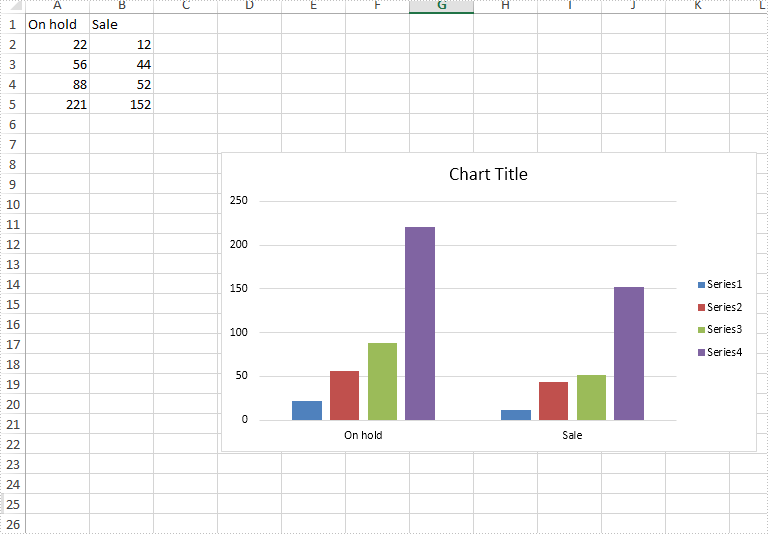
Note: Before Start, please download the latest version of Spire.XLS and add Spire.Xls.dll in the bin folder as the reference of Visual Studio.
Step 1: Create a new Excel workbook and load from file.
Workbook workbook = new Workbook();
workbook.LoadFromFile("Sample.xlsx");
Step 2: Get the first worksheet from workbook.
Worksheet worksheet = workbook.Worksheets[0];
Spire.Xls.Chart chart = worksheet.Charts[0];
Step 3: Format the font for the chart title.
chart.ChartTitleArea.Font.Color = Color.Blue;
chart.ChartTitleArea.Font.Size = 20.0;
Step 4: Format the font for the chart Axis.
chart.PrimaryValueAxis.Font.Color = Color.Gold;
chart.PrimaryValueAxis.Font.Size = 10.0;

chart.PrimaryCategoryAxis.Font.Color = Color.Red;
chart.PrimaryCategoryAxis.Font.Size = 20.0;
Step 5: Save the document to file.
workbook.SaveToFile("result.xlsx", FileFormat.Version2010);
Effective screenshot after formatting the font for the chart title and chart axis.
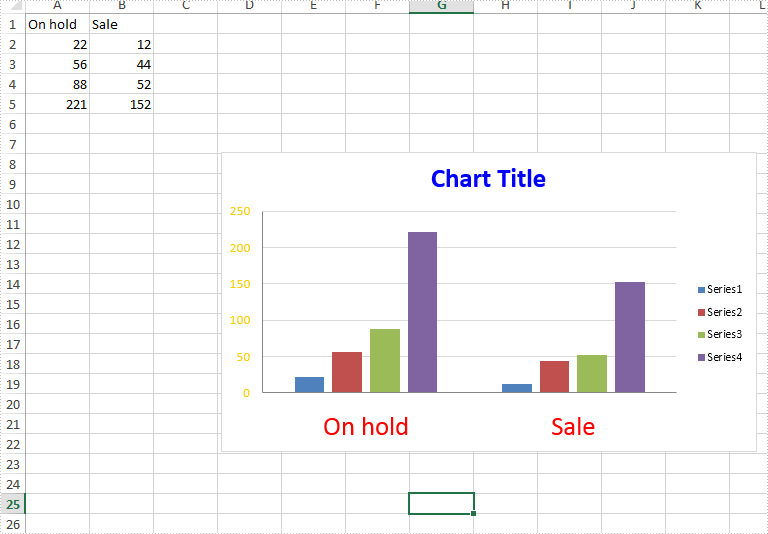
Full codes:
using Spire.Xls;
using System.Drawing;

namespace SetFont
{
    class Program
    {
        static void Main(string[] args)
        {
            Workbook workbook = new Workbook();
            workbook.LoadFromFile("Sample.xlsx");

            Worksheet worksheet = workbook.Worksheets[0];
            Spire.Xls.Chart chart = worksheet.Charts[0];

            chart.ChartTitleArea.Color = Color.Blue;
            chart.ChartTitleArea.Size = 20.0;

            chart.PrimaryValueAxis.Font.Color = Color.Gold;
            chart.PrimaryValueAxis.Font.Size = 10.0;

            chart.PrimaryCategoryAxis.Font.Color = Color.Red;
            chart.PrimaryCategoryAxis.Font.Size = 20.0;

            workbook.SaveToFile("result.xlsx", FileFormat.Version2010);
        }
    }
}
How to keep high quality image when convert XPS to PDF in C#
We have already had an article of showing how to convert the XPS files into PDF file. Starts from Spire.PDF V3.8.68, it newly supports to keep the high quality image on the resulted PDF file from the XPS document. Spire.PDF offers a property of pdf.UseHighQualityImage to set the image quality before loading the original XPS file. This article will focus on demonstrate how to save image with high quality for the conversion from XPS to PDF.
Here comes to the code snippets:
Step 1: Create a PDF instance.
PdfDocument pdf = new PdfDocument();
Step 2: Set the value of UseHighQualityImage as true to use the high quality image when convert XPS to PDF.
pdf.ConvertOptions.SetXpsToPdfOptions(true);
Step 3: Load the XPS document by use either the method of pdf.LoadFromFile() or pdf.LoadFromXPS().
pdf.LoadFromFile("Sample.xps",FileFormat.XPS);
Step 4: Save the document to file.
pdf.SaveToFile("result.pdf");
Effective screenshot of the high quality image after saving XPS as PDF file format:

Full codes:
using Spire.Pdf;

namespace ConvertXPStoPDF
{
    class Program
    {
        static void Main(string[] args)
        {
            PdfDocument pdf = new PdfDocument();

            pdf.ConvertOptions.SetXpsToPdfOptions(true);

            pdf.LoadFromFile("Sample.xps", FileFormat.XPS);
            //pdf.LoadFromXPS("Sample.xps");

            pdf.SaveToFile("result.pdf", FileFormat.PDF);
        }
    }
}
C#: Get Coordinates of Text or an Image in PDF
Getting the coordinates of text or an image in a PDF is a useful task that allows precise referencing and manipulation of specific elements within the document. By extracting the coordinates, one can accurately identify the position of text or images on each page. This information proves valuable for tasks like data extraction, text recognition, or highlighting specific areas. This article introduces how to get the coordinate information of text or an image in a PDF document in C# using Spire.PDF for .NET.
Install Spire.PDF for .NET
To begin with, you need to add the DLL files included in the Spire.PDF for .NET package as references in your .NET project. You can download Spire.PDF for .NET from our website or install it directly through NuGet.
PM> Install-Package Spire.PDF
Get Coordinates of Text in PDF in C#
The PdfTextFinder.Find() method provided by Spire.PDF can help us find all instances of the string to be searched in a searchable PDF document. The coordinate information of a specific instance can be obtained through the PdfTextFragment.Positions property. The following are the step to get the (X, Y) coordinates of the specified text in a PDF using Spire.PDF for .NET.
- Create a PdfDocument object.
- Load a PDF file using PdfDocument.LoadFromFile() method.
- Loop through the pages in the document.
- Create a PdfTextFinder object, and get all instances of the specified text from a page using PdfTextFinder.Find() method.
- Loop through the find results and get the coordinate information of a specific result through PdfTextFragment.Positions property.
- C#
using Spire.Pdf;
using Spire.Pdf.Texts;
using System.Collections.Generic;
using System;
using System.Drawing;

namespace GetCoordinatesOfText
{
    class Program
    {
        static void Main(string[] args)
        {
            //Create a PdfDocument object
            PdfDocument doc = new PdfDocument();

            //Load a PDF file
            doc.LoadFromFile("C:\\Users\\Administrator\\Desktop\\input.pdf");

            //Loop through all pages
            foreach (PdfPageBase page in doc.Pages)
            {
                //Create a PdfTextFinder object
                PdfTextFinder finder = new PdfTextFinder(page);

                //Set the find options
                PdfTextFindOptions options = new PdfTextFindOptions();
                options.Parameter = TextFindParameter.IgnoreCase;
                finder.Options = options;

                //Find all instances of a specific text
                List<PdfTextFragment> fragments = finder.Find("target audience");

                //Loop through the instances
                foreach (PdfTextFragment fragment in fragments)
                {
                    //Get the position of a specific instance
                    PointF found = fragment.Positions[0];
                    Console.WriteLine(found);
                }
            }
        }
    }
}

Get Coordinates of an Image in PDF in C#
Spire.PDF provides the PdfImageHelper.GetImagesInfo() method to help us get all image information on a specific page. The coordinate information of a specific image can be obtained through the PdfImageInfo.Bounds property. The following are the steps to get the coordinates of an image in a PDF document using Spire.PDF for .NET.
- Create a PdfDocument object.
- Load a PDF file using PdfDocument.LoadFromFile() method.
- Get a specific page through PdfDocument.Pages[index] property.
- Create a PdfImageHelper object, and get all image information from the page using PdfImageHelper.GetImageInfo() method.
- Get the coordinate information of a specific image through PdfImageInfo.Bounds property.
- C#
using Spire.Pdf;
using Spire.Pdf.Utilities;

namespace GetCoordinatesOfImage
{
    class Program
    {
        static void Main(string[] args)
        {
            //Create a PdfDocument object
            PdfDocument doc = new PdfDocument();

            //Load a PDF file
            doc.LoadFromFile("C:\\Users\\Administrator\\Desktop\\input.pdf");

            //Get a specific page
            PdfPageBase page = doc.Pages[0];

            //Create a PdfImageHelper object
            PdfImageHelper helper = new PdfImageHelper();

            //Get image information from the page
            PdfImageInfo[] images = helper.GetImagesInfo(page);

            //Get X,Y coordinates of a specific image
            float xPos = images[0].Bounds.X;
            float yPos = images[0].Bounds.Y;
            Console.WriteLine("The image is located at({0},{1})", xPos, yPos);
        }
    }
}

Apply for a Temporary License
If you'd like to remove the evaluation message from the generated documents, or to get rid of the function limitations, please request a 30-day trial license for yourself.
C#: Get the Font Information in PDF
Get PDF font information is the process of extracting details about the fonts used in a PDF document. This information typically includes the font name, size, type, color, and other attributes. Knowing these details can help in ensuring consistency, copyright compliance, and aesthetics of the PDF document. In this article, you will learn how to get the font information in PDF in C# using Spire.PDF for .NET.
Install Spire.PDF for .NET
To begin with, you need to add the DLL files included in the Spire.PDF for.NET package as references in your .NET project. The DLL files can be either downloaded from this link or installed via NuGet.
PM> Install-Package Spire.PDF
Get the Fonts of Specified Text in PDF in C#
With Spire.PDF for .NET, you can find specified text and get its font formatting such as font name, size, style and color through the corresponding properties of the PdfTextFragment class. The following are the detailed steps.
- Create a PdfDocument instance.
- Load a PDF file using PdfDocument.LoadFromFile() method.
- Get a specified page using PdfDocument.Pages[] property.
- Create a PdfTextFinder instance.
- Find the specified text using PdfTextFinder.Find() method and return a PdfTextFragment object.
- Create a StringBuilder instance to store information.
- Iterate through all found text.
- Get the found text using PdfTextFragment.Text property.
- Get the font name of the found text using PdfTextFragment.TextStates[0].FontName property.
- Get the font size of the found text using PdfTextFragment.TextStates[0].FontSize property.
- Get the font family of the found text using PdfTextFragment.TextStates[0].FontFamily property.
- Indicate whether the font is bold or faux bold (font style set to fill and stroke) using PdfTextFragment.TextStates[0].IsSimulateBold and PdfTextFragment.TextStates[0].IsItalic properties.
- Get the font color of the found text using PdfTextFragment.TextStates[0].ForegroundColor property.
- Append the font information to the StringBuilder instance using StringBuilder.AppendLine() method.
- Write to a txt file.
- C#
using Spire.Pdf;
using Spire.Pdf.Texts;
using System.Collections.Generic;
using System.Drawing;
using System.IO;
using System.Text;

namespace GetTextFont
{
    class Program
    {
        static void Main(string[] args)
        {
            // Create a PdfDocument instance
            PdfDocument pdf = new PdfDocument();

            // Load a PDF file
            pdf.LoadFromFile("NET Framework.pdf");

            // Get the first page
            PdfPageBase page = pdf.Pages[0];

            // Create a PdfTextFinder instance
            PdfTextFinder finds = new PdfTextFinder(page);

            // Find specified text on the page
            finds.Options.Parameter = TextFindParameter.None;
            List<PdfTextFragment> result = finds.Find(".NET Framework");

            // Create a StringBuilder instance
            StringBuilder str = new StringBuilder();

            // Iterate through all found text
            foreach (PdfTextFragment find in result)
            {
                // Get the found text
                string text = find.Text;
                // Get the font name
                string FontName = find.TextStates[0].FontName;
                // Get the font size
                float FontSize = find.TextStates[0].FontSize;
                // Get the font family
                string FontFamily = find.TextStates[0].FontFamily;
                // Indicate whether the font is bold or italic
                bool IsBold = find.TextStates[0].IsBold;
                bool IsSimulateBold = find.TextStates[0].IsSimulateBold;
                bool IsItalic = find.TextStates[0].IsItalic;
                // Get the font color
                Color color = find.TextStates[0].ForegroundColor;

                // Append the font information to the StringBuilder instance
                str.AppendLine(text);
                str.AppendLine("FontName: " + FontName);
                str.AppendLine("FontSize: " + FontSize);
                str.AppendLine("FontFamily: " + FontFamily);
                str.AppendLine("IsBold: " + IsBold);
                str.AppendLine("IsSimulateBold: " + IsSimulateBold);
                str.AppendLine("IsItalic: " + IsItalic);
                str.AppendLine("color: " + color);
                str.AppendLine(" ");
            }
            // Write to a txt file
            File.WriteAllText("PdfFont.txt", str.ToString());
        }
    }
}

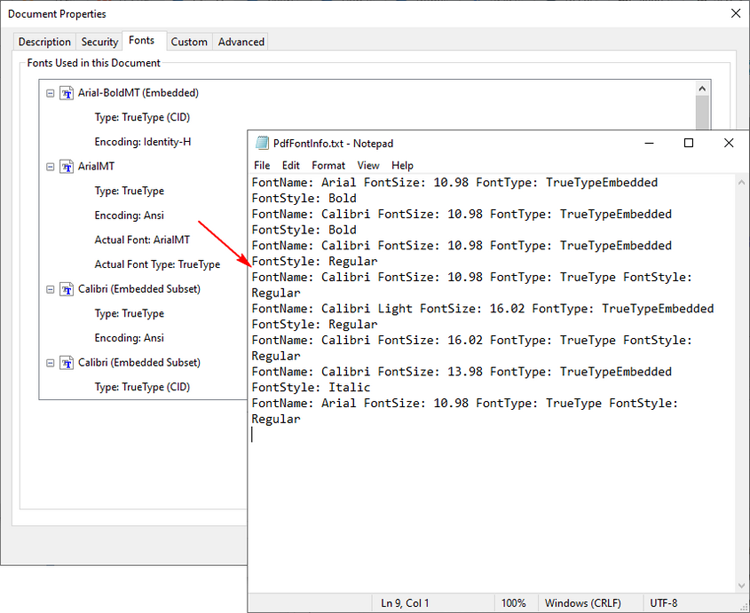
Get the Used Fonts in PDF in C#
Spire.PDF for .NET also provides the PdfUsedFont class to represent the fonts used in a PDF document. To get the formatting of all used fonts, you can iterate through each font and retrieve its font name, size, type and style using the corresponding properties of the PdfUsedFont class. The following are the detailed steps.
- Create a PdfDocument instance.
- Load a PDF file using PdfDocument.LoadFromFile() method.
- Get all the fonts used in the PDF file using PdfDocument.UsedFonts property.
- Create a StringBuilder instance to store information.
- Iterate through the used fonts.
- Get the font name using PdfUsedFont.Name property.
- Get the font size using PdfUsedFont.Size property.
- Get the font type using PdfUsedFont.Type property.
- Get the font style using PdfUsedFont.Style property.
- Append the font information to the StringBuilder instance using StringBuilder.AppendLine() method.
- Write to a txt file
- C#
using Spire.Pdf;
using Spire.Pdf.Graphics;
using Spire.Pdf.Graphics.Fonts;
using System.IO;
using System.Text;

namespace GetPdfFont
{
    class Program
    {
        static void Main(string[] args)
        {
            // Create a PdfDocument instance
            PdfDocument pdf = new PdfDocument();

            // Load a PDF file
            pdf.LoadFromFile("NET Framework.pdf");

            // Get the used fonts in the PDF file
            PdfUsedFont[] fonts = pdf.UsedFonts;

            // Create a StringBuilder instance
            StringBuilder str = new StringBuilder();

            // Iterate through the used fonts
            foreach (PdfUsedFont font in fonts)
            {
                // Get the font name
                string name = font.Name;

                // Get the font size
                float size = font.Size;

                // Get the font type
                PdfFontType type = font.Type;

                // Get the font style
                PdfFontStyle style = font.Style;

                // Append the font information to the StringBuilder instance
                str.AppendLine("FontName: " + name + " FontSize: " + size + " FontType: " + type + " FontStyle: " + style);

            }

            // Write to a txt file
            File.WriteAllText("PdfFontInfo.txt", str.ToString());
        }
    }
}
Apply for a Temporary License
If you'd like to remove the evaluation message from the generated documents, or to get rid of the function limitations, please request a 30-day trial license for yourself.
C#/VB.NET: Convert PDF to SVG
SVG (Scalable Vector Graphics) is an image file format used for rendering two-dimensional images on the web. Comparing with other image file formats, SVG has many advantages such as supporting interactivity and animation, allowing users to search, index, script, and compress/enlarge images without losing quality. Occasionally, you may need to convert PDF files to SVG file format, and this article will demonstrate how to accomplish this task using Spire.PDF for .NET.
- Convert a PDF File to SVG in C#/VB.NET
- Convert Selected PDF Pages to SVG in C#/VB.NET
- Convert a PDF File to SVG with Custom Width and Height in C#/VB.NET
Install Spire.PDF for .NET
To begin with, you need to add the DLL files included in the Spire.PDF for.NET package as references in your .NET project. The DLLs files can be either downloaded from this link or installed via NuGet.
PM> Install-Package Spire.PDF
Convert a PDF File to SVG in C#/VB.NET
Spire.PDF for .NET offers the PdfDocument.SaveToFile(String, FileFormat) method to convert each page in a PDF file to a single SVG file. The detailed steps are as follows.
- Create a PdfDocument object.
- Load a sample PDF file using PdfDocument.LoadFromFile() method.
- Convert the PDF file to SVG using PdfDocument.SaveToFile(String, FileFormat) method.
- C#
- VB.NET
using Spire.Pdf;

namespace ConvertPDFtoSVG
{
    class Program
    {
        static void Main(string[] args)
        {
            //Create a PdfDocument object
            PdfDocument document = new PdfDocument();

            //Load a sample PDF file
            document.LoadFromFile("input.pdf");

            //Convert PDF to SVG
            document.SaveToFile("PDFtoSVG.svg", FileFormat.SVG);
        }
    }
}

Convert Selected PDF Pages to SVG in C#/VB.NET
The PdfDocument.SaveToFile(String, Int32, Int32, FileFormat) method allows you to convert the specified pages in a PDF file to SVG files. The detailed steps are as follows.
- Create a PdfDocument object.
- Load a sample PDF file using PdfDocument.LoadFromFile() method.
- Convert selected PDF pages to SVG using PdfDocument.SaveToFile(String, Int32, Int32, FileFormat) method.
- C#
- VB.NET
using Spire.Pdf;

namespace PDFPagetoSVG
{
    class Program
    {
        static void Main(string[] args)
        {
            //Create a PdfDocument object
            PdfDocument doc = new PdfDocument();

            //Load a sample PDF file
            doc.LoadFromFile("input.pdf");

            //Convert selected PDF pages to SVG
            doc.SaveToFile("PDFPagetoSVG.svg", 1, 2, FileFormat.SVG);
        }
    }
}

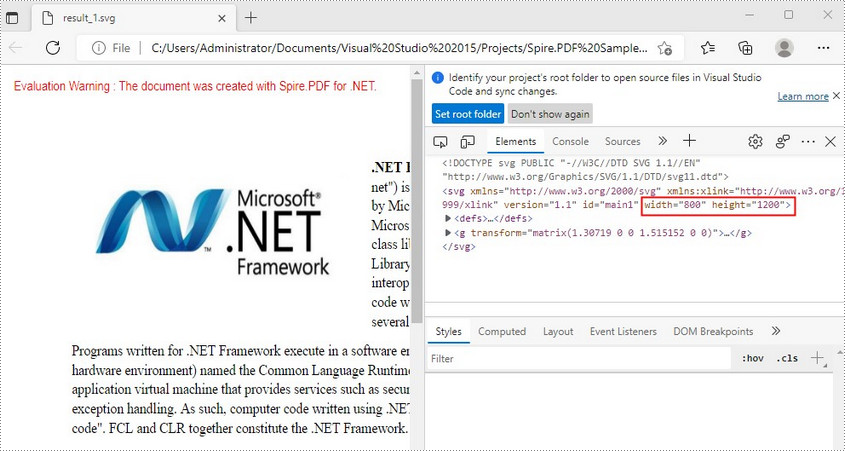
Convert a PDF File to SVG with Custom Width and Height in C#/VB.NET
The PdfConvertOptions.SetPdfToSvgOptions() method offered by Spire.PDF for .NET allows you to specify the width and height of output SVG file. The detailed steps are as follows.
- Create a PdfDocument object.
- Load a sample PDF file using PdfDocument.LoadFromFile() method.
- Set PDF convert options using PdfDocument.ConvertOptions property.
- Specify the width and height of output SVG file using PdfConvertOptions.SetPdfToSvgOptions() method.
- Convert the PDF file to SVG using PdfDocument.SaveToFile() method.
- C#
- VB.NET
using Spire.Pdf;

namespace PDFtoSVG
{
    class Program
    {
        static void Main(string[] args)
        {
            //Create a PdfDocument object
            PdfDocument document = new PdfDocument();

            //Load a sample PDF file
            document.LoadFromFile("input.pdf");

            //Specify the width and height of output SVG file
            PdfToSvgConverter converter = new PdfToSvgConverter(inputFile);
            converter.SvgOptions.ScaleX = (float)0.5;
            converter.SvgOptions.ScaleY = (float)0.5;
            converter.Convert(outputFile);


            //Convert PDF to SVG
            document.SaveToFile("result.svg", FileFormat.SVG);
        }
    }
}
Apply for a Temporary License
If you'd like to remove the evaluation message from the generated documents, or to get rid of the function limitations, please request a 30-day trial license for yourself.
C#/VB.NET: Add Image Watermarks to PDF
An image watermark is usually a logo or sign that appears on the background of digital documents, indicating the copyright owner of the content. Watermarking your PDF document with an image can prevent your data from being reused or modified. This article demonstrates how to add an image watermark to PDF in C# and VB.NET using Spire.PDF for .NET.
Install Spire.PDF for .NET
To begin with, you need to add the DLL files included in the Spire.PDF for.NET package as references in your .NET project. The DLLs files can be either downloaded from this link or installed via NuGet.
- Package Manager
PM> Install-Package Spire.PDF
Add an Image Watermark to PDF
The following are the main steps to add an image watermark to a PDF document.
- Create a PdfDocument object, and load a sample PDF file using PdfDocument.LoadFromFile() method.
- Load an image file using Image.FromFile() method.
- Loop through the pages in the document, and get the specific page through PdfDocument.Pages[] property.
- Set the image as background/watermark image of the current page through PdfPageBase.BackgroundImage property. Set the image position and size through PdfPageBase.BackgroundRegion property.
- Save the document to a different PDF file using PdfDocument.SaveToFile() method.
- C#
- VB.NET
using Spire.Pdf;
using System.Drawing;

namespace AddImageWatermark
{
    class Program
    {
        static void Main(string[] args)
        {
            //Create a PdfDocument object
            PdfDocument document = new PdfDocument();

            //Load a sample PDF document
            document.LoadFromFile(@"C:\Users\Administrator\Desktop\sample.pdf");

            //Load an image
            Image image = Image.FromFile(@"C:\Users\Administrator\Desktop\logo.png");

            //Get the image width and height
            int imgWidth = image.Width;
            int imgHeight = image.Height;

            //Loop through the pages
            for (int i = 0; i < document.Pages.Count; i++)
            {
                //Get the page width and height
                float pageWidth = document.Pages[i].ActualSize.Width;
                float pageHeight = document.Pages[i].ActualSize.Height;

                //Set the background opacity
                document.Pages[i].BackgroudOpacity = 0.3f;

                //Set the background image of current page
                document.Pages[i].BackgroundImage = image;

                //Position the background image at the center of the page
                Rectangle rect = new Rectangle((int)(pageWidth - imgWidth) / 2, (int)(pageHeight - imgHeight) / 2, imgWidth, imgHeight);
                document.Pages[i].BackgroundRegion = rect;
            }

            //Save the document to file
            document.SaveToFile("AddImageWatermark.pdf");
            document.Close();
        }
    }
}
Imports Spire.Pdf
Imports System.Drawing

Namespace AddImageWatermark
    Class Program
        Shared  Sub Main(ByVal args() As String)
            'Create a PdfDocument object
            Dim document As PdfDocument =  New PdfDocument()

            'Load a sample PDF document
            document.LoadFromFile("C:\Users\Administrator\Desktop\sample.pdf")

            'Load an image
            Dim image As Image =  Image.FromFile("C:\Users\Administrator\Desktop\logo.png")

            'Get the image width and height
            Dim imgWidth As Integer =  image.Width
            Dim imgHeight As Integer =  image.Height

            'Loop through the pages
            Dim i As Integer
            For  i = 0 To  document.Pages.Count- 1  Step  i + 1
                'Get the page width and height
                Dim pageWidth As single =  document.Pages(i).ActualSize.Width
                Dim pageHeight As single =  document.Pages(i).ActualSize.Height

                'Set the background opacity
                document.Pages(i).BackgroudOpacity = 0.3f

                'Set the background image of current page
                document.Pages(i).BackgroundImage = image

                Dim rect As Rectangle = New Rectangle(CInt((pageWidth - imgWidth) / 2), CInt((pageHeight - imgHeight) / 2), imgWidth, imgHeight)
                document.Pages(i).BackgroundRegion = rect
            Next

            'Save the document to file
            document.SaveToFile("AddImageWatermark.pdf")
            document.Close()
        End Sub
    End Class
End Namespace
Apply for a Temporary License
If you'd like to remove the evaluation message from the generated documents, or to get rid of the function limitations, please request a 30-day trial license for yourself.
C#: Add Page Numbers to a PDF Document
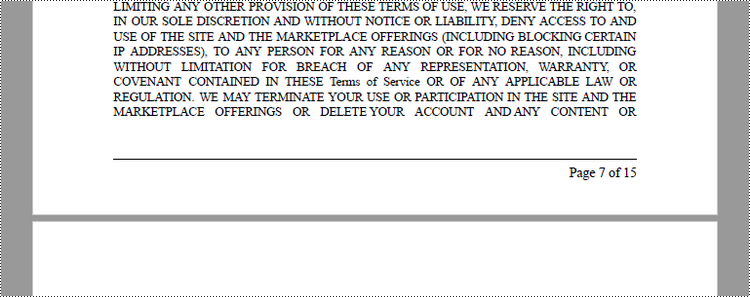
Adding page numbers to a PDF document is not only practical but also aesthetically pleasing, as it provides a polished look akin to professionally published materials. Whether you're dealing with a digital copy of a novel, a report, or any other type of lengthy document, having page numbers can significantly improve its readability and utility. In this article, you will learn how to add page numbers to a PDF document in C# using Spire.PDF for .NET.
- Add Left-Aligned Page Numbers in the Footer in C#
- Add Center-Aligned Page Numbers in the Footer in C#
- Add Right-Aligned Page Numbers in the Footer in C#
Install Spire.PDF for .NET
To begin with, you need to add the DLL files included in the Spire.PDF for.NET package as references in your .NET project. The DLL files can be either downloaded from this link or installed via NuGet.
PM> Install-Package Spire.PDF
PDF Coordinate System
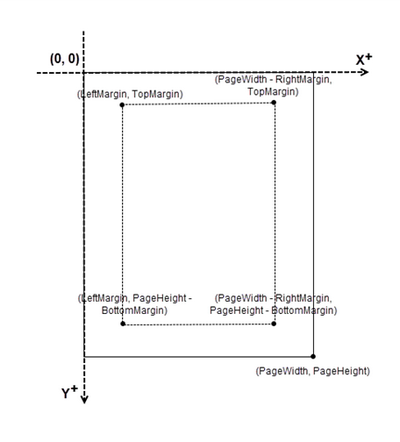
When utilizing Spire.PDF for .NET to manipulate an existing PDF document, it's important to note that the coordinate system's origin is located at the top left corner of the page. The x-axis extends to the right, while the y-axis extends downward.
Typically, page numbers are positioned within the header or footer section of a document. Therefore, it is crucial to take into account the page size and margins when determining the appropriate placement for the page numbers.
Add Left-Aligned Page Numbers in the Footer in C#
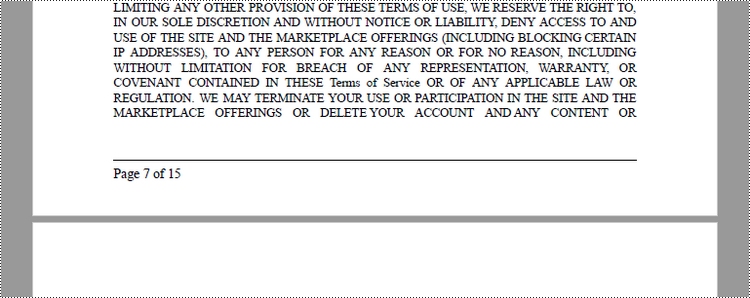
In the Spire.PDF for .NET library, there are two classes available: PdfPageNumberField and PdfPageCountField. These classes allow you to retrieve and display the current page number and the total page count when they are added to a page of a PDF document. If you wish to insert text such as "Page X" or "Page X of Y", you can utilize the PdfCompositeField class, which enables you to combine the desired text with one or more fields into a single field.
The following are the steps to add left-aligned page numbers in the PDF footer using C#.
- Create a Document object.
- Load a PDF file from a specified page.
- Create a PdfPageNumberField object and a PdfPageCountField object.
- Create a PdfCompositeField object to create a "Page X of Y" format.
- Specify the location of the PdfCompositeField object using PdfCompositeField.Location property.
- Iterate though the pages in the document, and add "Page X of Y" to the left corner of the footer section using PdfCompositeField.Draw() method.
- Save the document to a different PDF file.
- C#
using Spire.Pdf.AutomaticFields;
using Spire.Pdf.Graphics;
using Spire.Pdf;
using System.Drawing;
using Spire.Pdf.License;

namespace AddPageNumbersToLeftCorner
{
    class Program
    {
        static void Main(string[] args)
        {
            // Apply your license key
            LicenseProvider.SetLicenseKey("License Key");

            // Create a PdfDocument object
            PdfDocument doc = new PdfDocument();

            // Load a PDF file
            doc.LoadFromFile("C:\\Users\\Administrator\\Desktop\\Terms of service.pdf");

            // Create font, brush and pen, which determine the appearance of the page numbers to be added
            PdfTrueTypeFont font = new PdfTrueTypeFont(new Font("Times New Roman", 12, FontStyle.Regular), true);
            PdfBrush brush = PdfBrushes.Black;
            PdfPen pen = new PdfPen(brush, 1.0f);

            // Create a PdfPageNumberField object and a PdfPageCountField object
            PdfPageNumberField pageNumberField = new PdfPageNumberField();
            PdfPageCountField pageCountField = new PdfPageCountField();

            // Create a PdfCompositeField object to combine page count field and page number field in a single field
            PdfCompositeField compositeField = new PdfCompositeField(font, brush, "Page {0} of {1}", pageNumberField, pageCountField);

            // Get the page size
            SizeF pageSize = doc.Pages[0].Size;

            // Set the location of the composite field
            compositeField.Location = new PointF(72, pageSize.Height - 45);

            // Iterate through the pages in the document
            for (int i = 0; i < doc.Pages.Count; i++)
            {

                // Get a specific page
                PdfPageBase page = doc.Pages[i];

                // Draw a line at the specified position
                page.Canvas.DrawLine(pen, 72, pageSize.Height - 50, pageSize.Width - 72, pageSize.Height - 50);

                // Draw the composite field on the page
                compositeField.Draw(page.Canvas);
            }

            // Save to a different PDF file
            doc.SaveToFile("AddPageNumbersToLeftCorner.pdf");

            // Dispose resources
            doc.Dispose();
        }
    }
}
Add Center-Aligned Page Numbers in the Footer in C#
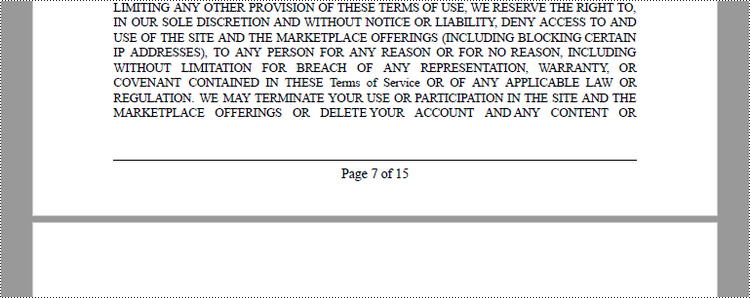
In order to align the page number in the footer section to the center, it is crucial to dynamically calculate the width of the text "Page X of Y." This calculation is essential as it determines the X coordinate of the page number (PdfCompositeField). To achieve center alignment, the X coordinate is calculated by subtracting the width of the page number from the page width and dividing the result by 2, as follows: (PageWidth - PageNumberWidth)/2.
The following are the steps to add center-aligned page numbers in the PDF footer using C#.
- Create a Document object.
- Load a PDF file from a specified page.
- Create a PdfPageNumberField object and a PdfPageCountField object.
- Create a PdfCompositeField object to create a "Page X of Y" format.
- Specify the location of the PdfCompositeField object using PdfCompositeField.Location property.
- Iterate though the pages in the document, and add "Page X of Y" to the center of the footer section using PdfCompositeField.Draw() method.
- Save the document to a different PDF file.
- C#
using Spire.Pdf.AutomaticFields;
using Spire.Pdf.Graphics;
using Spire.Pdf;
using System.Drawing;
using Spire.Pdf.License;

namespace AddPageNumbersToCenter
{
    class Program
    {
        static void Main(string[] args)
        {
            // Apply your license key
            LicenseProvider.SetLicenseKey("License Key");

            // Create a PdfDocument object
            PdfDocument doc = new PdfDocument();

            // Load a PDF file
            doc.LoadFromFile("C:\\Users\\Administrator\\Desktop\\Terms of service.pdf");

            // Create font, brush and pen, which determine the appearance of the page numbers to be added
            PdfTrueTypeFont font = new PdfTrueTypeFont(new Font("Times New Roman", 12, FontStyle.Regular), true);
            PdfBrush brush = PdfBrushes.Black;
            PdfPen pen = new PdfPen(brush, 1.0f);

            // Create a PdfPageNumberField object and a PdfPageCountField object
            PdfPageNumberField pageNumberField = new PdfPageNumberField();
            PdfPageCountField pageCountField = new PdfPageCountField();

            // Create a PdfCompositeField object to combine page count field and page number field in a single field
            PdfCompositeField compositeField = new PdfCompositeField(font, brush, "Page {0} of {1}", pageNumberField, pageCountField);


            // Iterate through the pages in the document
            for (int i = 0; i < doc.Pages.Count; i++)
            {

                // Get a specific page
                PdfPageBase page = doc.Pages[i];

                // Get the page size
                SizeF pageSize = doc.Pages[i].Size;

                // Draw a line at the specified position
                page.Canvas.DrawLine(pen, 72, pageSize.Height - 50, pageSize.Width - 72, pageSize.Height - 50);

                // Measure the size the "Page X of Y"
                SizeF pageNumberSize = font.MeasureString(string.Format("Page {0} of {1}", i + 1, doc.Pages.Count));

                // Set the location of the composite field
                compositeField.Location = new PointF((pageSize.Width - pageNumberSize.Width) / 2, pageSize.Height - 45);

                // Draw the composite field on the page
                compositeField.Draw(page.Canvas);

            }

            // Save to a different PDF file
            doc.SaveToFile("AddPageNumbersToCenter.pdf");

            // Dispose resources
            doc.Dispose();
        }
    }
}
Add Right-Aligned Page Numbers in the Footer in C#
To position the page number in the footer section's right corner, it is essential to dynamically calculate the width of the text "Page X of Y" as well. Because the X coordinate of the page number (PdfCompositeField) is determined by subtracting the combined width of the page number and the right page margin from the page width, as follows: PageWidth - (PageNumberWidth + RightPageMargin).
Below are the steps to add right-aligned page numbers in the PDF footer in C#.
- Create a Document object.
- Load a PDF file from a specified page.
- Create a PdfPageNumberField object and a PdfPageCountField object.
- Create a PdfCompositeField object to create a "Page X of Y" format.
- Specify the location of the PdfCompositeField object using PdfCompositeField.Location property.
- Iterate though the pages in the document, and add "Page X of Y" to the right corner of the footer section using PdfCompositeField.Draw() method.
- Save the document to a different PDF file.
- C#
using Spire.Pdf.AutomaticFields;
using Spire.Pdf.Graphics;
using Spire.Pdf;
using System.Drawing;
using Spire.Pdf.License;

namespace AddPageNumbersToRigthCorner
{
    class Program
    {
        static void Main(string[] args)
        {
            // Apply your license key
            LicenseProvider.SetLicenseKey("License Key");

            // Create a PdfDocument object
            PdfDocument doc = new PdfDocument();

            // Load a PDF file
            doc.LoadFromFile("C:\\Users\\Administrator\\Desktop\\Terms of service.pdf");

            // Create font, brush and pen, which determine the appearance of the page numbers to be added
            PdfTrueTypeFont font = new PdfTrueTypeFont(new Font("Times New Roman", 12, FontStyle.Regular), true);
            PdfBrush brush = PdfBrushes.Black;
            PdfPen pen = new PdfPen(brush, 1.0f);

            // Create a PdfPageNumberField object and a PdfPageCountField object
            PdfPageNumberField pageNumberField = new PdfPageNumberField();
            PdfPageCountField pageCountField = new PdfPageCountField();

            // Create a PdfCompositeField object to combine page count field and page number field in a single field
            PdfCompositeField compositeField = new PdfCompositeField(font, brush, "Page {0} of {1}", pageNumberField, pageCountField);


            // Iterate through the pages in the document
            for (int i = 0; i < doc.Pages.Count; i++)
            {

                // Get a specific page
                PdfPageBase page = doc.Pages[i];

                // Get the page size
                SizeF pageSize = doc.Pages[i].Size;

                // Draw a line at the specified position
                page.Canvas.DrawLine(pen, 72, pageSize.Height - 50, pageSize.Width - 72, pageSize.Height - 50);

                // Measure the size the "Page X of Y"
                SizeF pageNumberSize = font.MeasureString(string.Format("Page {0} of {1}", i + 1, doc.Pages.Count));

                // Set the location of the composite field
                compositeField.Location = new PointF(pageSize.Width - pageNumberSize.Width - 72, pageSize.Height - 45);

                // Draw the composite field on the page
                compositeField.Draw(page.Canvas);

            }

            // Save to a different PDF file
            doc.SaveToFile("AddPageNumbersToRigthCorner.pdf");

            // Dispose resources
            doc.Dispose();
        }
    }
}
Apply for a Temporary License
If you'd like to remove the evaluation message from the generated documents, or to get rid of the function limitations, please request a 30-day trial license for yourself.
Covert PDF to EMF image file format in C#
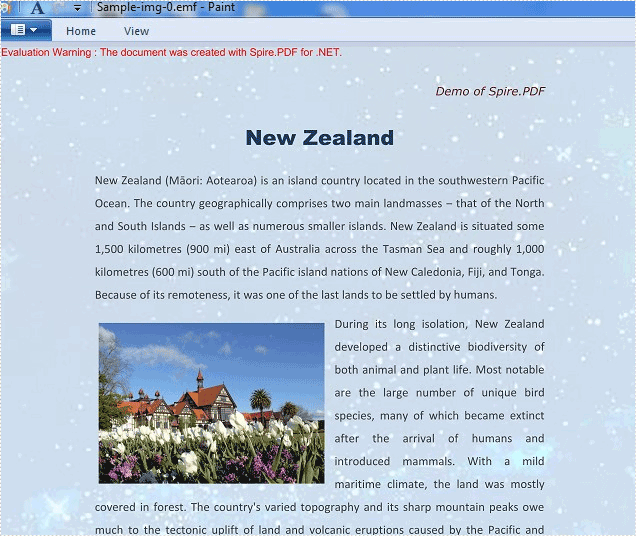
Spire.PDF supports to save the PDF files into different image file formats, such as BMP, JPG, PNG, GIF and TIFF. It also supports to save the PDF files as the Enhanced Metafile (EMF) image file format. This article will demonstrate how to save the PDF file as the EMF image file format in C#. With the help of Spire.PDF, we only need three lines of codes to finish the conversion function.
Note: Before Start, please download the latest version of Spire.PDF and add Spire.Pdf.dll in the bin folder as the reference of Visual Studio.
Here comes to the steps of how to export the PDF file to EMF in C#:
Step 1: Create a new PDF document and load from file.
PdfDocument doc = new PdfDocument();
doc.LoadFromFile("sample.pdf");
Step 2: Call to use the SaveAsImage method to save all the PDF pages as System.Drawing.Imaging.ImageFormat.Emf file format.
for (int i = 0; i < doc.Pages.Count; i++)
{
    String fileName = String.Format("Sample-img-{0}.emf", i);
    using (Image image = doc.SaveAsImage(i, Spire.Pdf.Graphics.PdfImageType.Bitmap, 300, 300))
     {
       image.Save(fileName, System.Drawing.Imaging.ImageFormat.Emf);
     }

}
Effective screenshot:
Full codes:
using Spire.Pdf;
using System;
using System.Drawing;

namespace ConvertPDFtoEMF
{
    class Program
    {
        static void Main(string[] args)
        {
            PdfDocument doc = new PdfDocument();
            doc.LoadFromFile("sample.pdf");

            for (int i = 0; i < doc.Pages.Count; i++)
            {
              using (Image image = doc.SaveAsImage(i, Spire.Pdf.Graphics.PdfImageType.Bitmap, 300, 300))
               {
                 image.Save(fileName, System.Drawing.Imaging.ImageFormat.Emf);
               }

            }
        }
    }
}
C#/VB.NET: Create a Table of Contents (TOC) in PDF
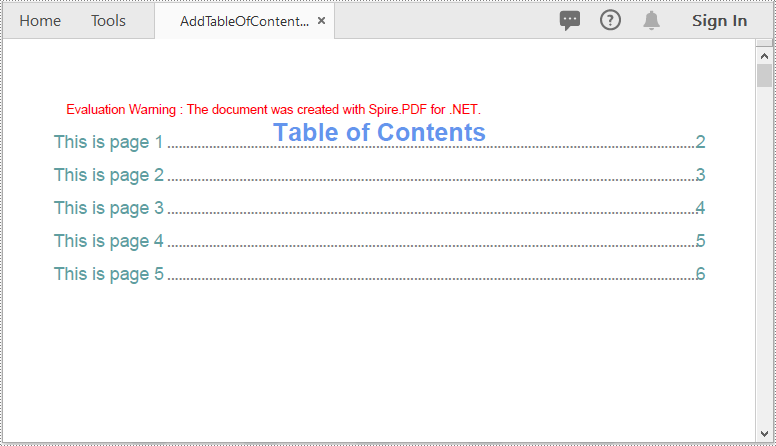
The table of contents plays a critical role in enhancing the readability and navigability of a document. It provides readers with a clear overview of the document's structure and enables them to quickly locate and access specific sections or information they are interested in. This can be especially valuable for longer documents, such as reports, books, or academic papers, where readers may need to refer back to specific sections or chapters multiple times. In this article, we'll explore how to create a table of contents in a PDF document in C# and VB.NET using Spire.PDF for .NET.
Install Spire.PDF for .NET
To begin with, you need to add the DLL files included in the Spire.PDF for.NET package as references in your .NET project. The DLL files can be either downloaded from this link or installed via NuGet.
PM> Install-Package Spire.PDF
Create a Table of Contents in PDF in C# and VB.NET
A table of contents mainly includes the TOC title (e.g. Table of Contents), TOC content, page numbers, and actions that will take you to the target pages when clicked on. To create a table of contents in PDF using Spire.PDF for .NET, you can follow these steps:
- Initialize an instance of the PdfDocument class.
- Load a PDF document using PdfDocument.LoadFromFile() method.
- Get the page count of the document using PdfDocument.Pages.Count property.
- Insert a new page into the PDF document as the first page using PdfDocument.Pages.Insert(0) method.
- Draw the TOC title, TOC content, and page numbers on the page using PdfPageBase.Canvas.DrawString() method.
- Create actions using PdfLinkAnnotation class and add the actions to the page using PdfNewPage.AnnotationsV2.Add() method.
- Save the result document using PdfDocument.SaveToFile() method.
- C#
- VB.NET
using Spire.Pdf;
using Spire.Pdf.Actions;
using Spire.Pdf.Interactive.Annotations;
using Spire.Pdf.Destinations;
using Spire.Pdf.Graphics;
using System;
using System.Drawing;

namespace TableOfContents
{
    internal class Program
    {
        static void Main(string[] args)
        {
            //Initialize an instance of the PdfDocument class
            PdfDocument doc = new PdfDocument();
            //Load a PDF document
            doc.LoadFromFile("Sample.PDF");

            //Get the page count of the document
            int pageCount = doc.Pages.Count;

            //Insert a new page into the pdf document as the first page
            PdfPageBase tocPage = doc.Pages.Insert(0);

            //Draw TOC title on the new page
            string title = "Table of Contents";
            PdfTrueTypeFont titleFont = new PdfTrueTypeFont(new Font("Arial", 20, FontStyle.Bold));
            PdfStringFormat centerAlignment = new PdfStringFormat(PdfTextAlignment.Center, PdfVerticalAlignment.Middle);
            PointF location = new PointF(tocPage.Canvas.ClientSize.Width / 2, titleFont.MeasureString(title).Height + 10);
            tocPage.Canvas.DrawString(title, titleFont, PdfBrushes.CornflowerBlue, location, centerAlignment);

            //Draw TOC content on the new page
            PdfTrueTypeFont titlesFont = new PdfTrueTypeFont(new Font("Arial", 14));
            String[] titles = new String[pageCount];
            for (int i = 0; i < titles.Length; i++)
            {
                titles[i] = string.Format("This is page {0}", i + 1);
            }
            float y = titleFont.MeasureString(title).Height + 10;
            float x = 0;

            //Draw page numbers of the target pages on the new page
            for (int i = 1; i <= pageCount; i++)
            {
                string text = titles[i - 1];
                SizeF titleSize = titlesFont.MeasureString(text);

                PdfPageBase navigatedPage = doc.Pages[i];

                string pageNumText = (i + 1).ToString();
                SizeF pageNumTextSize = titlesFont.MeasureString(pageNumText);
                tocPage.Canvas.DrawString(text, titlesFont, PdfBrushes.CadetBlue, 0, y);
                float dotLocation = titleSize.Width + 2 + x;
                float pageNumlocation = tocPage.Canvas.ClientSize.Width - pageNumTextSize.Width;
                for (float j = dotLocation; j < pageNumlocation; j++)
                {
                    if (dotLocation >= pageNumlocation)
                    {
                        break;
                    }
                    tocPage.Canvas.DrawString(".", titlesFont, PdfBrushes.Gray, dotLocation, y);
                    dotLocation += 3;
                }
                tocPage.Canvas.DrawString(pageNumText, titlesFont, PdfBrushes.CadetBlue, pageNumlocation, y);

                //Add actions that will take you to the target pages when clicked on to the new page
                location = new PointF(0, y);
                RectangleF titleBounds = new RectangleF(location, new SizeF(tocPage.Canvas.ClientSize.Width, titleSize.Height));
                PdfXYZExplicitDestination Dest = new PdfXYZExplicitDestination(navigatedPage, -doc.PageSettings.Margins.Top, -doc.PageSettings.Margins.Left);
                PdfLinkAnnotation action = new PdfLinkAnnotation(tocPage, titleBounds, new PdfGoToAction(Dest));
                action.Border.Width = 0;
                (tocPage as PdfNewPage).AnnotationsV2.Add(action);
                y += titleSize.Height + 10;
            }

            //Save the result pdf document
            doc.SaveToFile("AddTableOfContents.pdf");
            doc.Close();
        }
    }
}
Apply for a Temporary License
If you'd like to remove the evaluation message from the generated documents, or to get rid of the function limitations, please request a 30-day trial license for yourself.