
Knowledgebase (2370)
Children categories
Inserting charts to your PPT document is an easy and eye catching way to display important information. Spire.Presentation includes many different types of data charts including column charts, cylinder charts, cone charts, pyramid charts, clustered charts, line charts, pie charts, bar charts, area charts, scatter charts, stock charts, surface charts, contour charts, doughnut charts, bubble charts and radar charts.
Spire.Presentation for .NET, a reliable .NET PPT component, enables you to generate, read, edit, convert even print your PPT documents without installing Microsoft PowerPoint on your machine. Using Spire.Presentation for .NET, you also can insert charts in your PPT document with C#. Please see the target PPT document with chart as below picture:
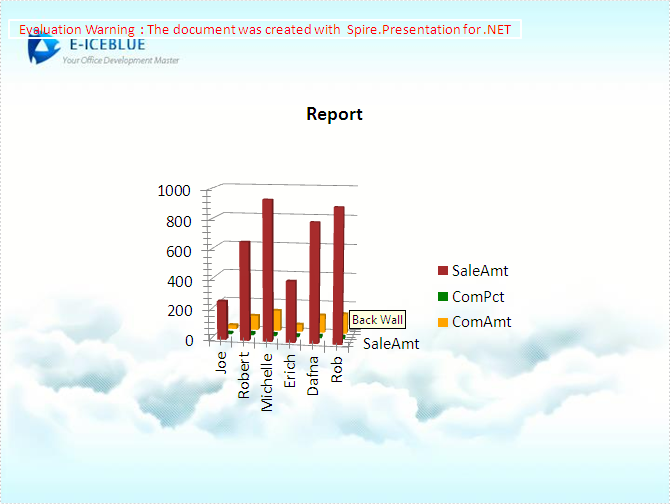
The steps of method are:
Step 1: Create the PPT document.
Presentation presentation = new Presentation();
Step 2: Insert chart, set title and style of the chart.
RectangleF rect = new RectangleF(presentation.SlideSize.Size.Width / 2 - 200, 100, 400, 400);
IChart chart = presentation.Slides[0].Shapes.AppendChart(Spire.Presentation.Charts.ChartType.Cylinder3DClustered, rect);
chart.ChartTitle.TextProperties.Text = "Report";
chart.ChartTitle.TextProperties.IsCentered = true;
chart.ChartTitle.Height = 30;
chart.HasTitle = true;
Step 3: Prepare data for the chart. Load a simple DataTable from XML file via LoadData() method.
DataTable dataTable = LoadData();
private DataTable LoadData()
{
    DataSet ds = new DataSet();
    ds.ReadXmlSchema("data-schema.xml");
    ds.ReadXml("data.xml");
    return ds.Tables[0];
}
Step 4: Attach the data to chart. We can use chart.ChartData[rowIndex, columnIndex] to get/set the value of the specified cell in the data table of chart. Using the property chart.ChartData[rowIndex, columnIndex].Text to get/set the text value. Using the property chart.ChartData[rowIndex, columnIndex].Value to get/set numeric value. In this article we define a method InitChartData to attach the Data of the chart.
private void InitChartData(IChart chart, DataTable dataTable)
{
    for (int c = 0; c < dataTable.Columns.Count; c++)
    {
        chart.ChartData[0, c].Text = dataTable.Columns[c].Caption;
    }

    for (int r = 0; r < dataTable.Rows.Count; r++)
    {
        object[] data = dataTable.Rows[r].ItemArray;
        for (int c = 0; c < data.Length; c++)
        {
            chart.ChartData[r + 1, c].Value = data[c];
        }
    }
}
Step 5: Set the Series label and Category label.
chart.Series.SeriesLabel = chart.ChartData["B1", "D1"];
chart.Categories.CategoryLabels = chart.ChartData["A2", "A7"];
Step 6: Assign data to each Series and set each Series' fill color.
chart.Series[0].Values = chart.ChartData["B2", "B7"];
chart.Series[0].Fill.FillType = FillFormatType.Solid;
chart.Series[0].Fill.SolidColor.KnownColor = KnownColors.Brown;
chart.Series[1].Values = chart.ChartData["C2", "C7"];
chart.Series[1].Fill.FillType = FillFormatType.Solid;
chart.Series[1].Fill.SolidColor.KnownColor = KnownColors.Green;
chart.Series[2].Values = chart.ChartData["D2", "D7"];
chart.Series[2].Fill.FillType = FillFormatType.Solid;
chart.Series[2].Fill.SolidColor.KnownColor = KnownColors.Orange;
Step 7: Set the 3D rotation.
chart.RotationThreeD.XDegree = 10;
chart.RotationThreeD.YDegree = 10;
Step 8: Save the document.
presentation.SaveToFile("chart.pptx", FileFormat.Pptx2010);
Download and install Spire.Presentation for .NET and use below code to experience this method to insert charts in PPT document.
The full code:
using Spire.Presentation;
using Spire.Presentation.Charts;
using Spire.Presentation.Drawing;
using System;
using System.Data;
using System.Drawing;

namespace InsertChart
{

    class Program
    {


        private void btnRun_Click(object sender, EventArgs e)
        {
            //create PPT document
            Presentation presentation = new Presentation();

            //set background Image
            string ImageFile = "bg.png";
            RectangleF rect2 = new RectangleF(0, 0, presentation.SlideSize.Size.Width, presentation.SlideSize.Size.Height);
            presentation.Slides[0].Shapes.AppendEmbedImage(ShapeType.Rectangle, ImageFile, rect2);
            presentation.Slides[0].Shapes[0].Line.FillFormat.SolidFillColor.Color = Color.FloralWhite;

            //insert chart
            RectangleF rect = new RectangleF(presentation.SlideSize.Size.Width / 2 - 200, 100, 400, 400);
            IChart chart = presentation.Slides[0].Shapes.AppendChart(Spire.Presentation.Charts.ChartType.Cylinder3DClustered, rect);

            //add chart Title
            chart.ChartTitle.TextProperties.Text = "Report";
            chart.ChartTitle.TextProperties.IsCentered = true;
            chart.ChartTitle.Height = 30;
            chart.HasTitle = true;

            //load data from XML file to datatable
            DataTable dataTable = LoadData();
            //load data from datatable to chart
            InitChartData(chart, dataTable);
            chart.Series.SeriesLabel = chart.ChartData["B1", "D1"];
            chart.Categories.CategoryLabels = chart.ChartData["A2", "A7"];
            chart.Series[0].Values = chart.ChartData["B2", "B7"];
            chart.Series[0].Fill.FillType = FillFormatType.Solid;
            chart.Series[0].Fill.SolidColor.KnownColor = KnownColors.Brown;
            chart.Series[1].Values = chart.ChartData["C2", "C7"];
            chart.Series[1].Fill.FillType = FillFormatType.Solid;
            chart.Series[1].Fill.SolidColor.KnownColor = KnownColors.Green;
            chart.Series[2].Values = chart.ChartData["D2", "D7"];
            chart.Series[2].Fill.FillType = FillFormatType.Solid;
            chart.Series[2].Fill.SolidColor.KnownColor = KnownColors.Orange;
            //set the 3D rotation
            chart.RotationThreeD.XDegree = 10;
            chart.RotationThreeD.YDegree = 10;
            //save the document
            presentation.SaveToFile("chart.pptx", FileFormat.Pptx2010);
            System.Diagnostics.Process.Start("chart.pptx");

        }

        //function to load data from XML file to DataTable
        private DataTable LoadData()
        {
            DataSet ds = new DataSet();
            ds.ReadXmlSchema("data-schema.xml");
            ds.ReadXml("data.xml");
            return ds.Tables[0];
        }

        //function to load data from DataTable to IChart
        private void InitChartData(IChart chart, DataTable dataTable)
        {
            for (int c = 0; c < dataTable.Columns.Count; c++)
            {
                chart.ChartData[0, c].Text = dataTable.Columns[c].Caption;
            }
            for (int r = 0; r < dataTable.Rows.Count; r++)
            {
                object[] data = dataTable.Rows[r].ItemArray;
                for (int c = 0; c < data.Length; c++)
                {
                    chart.ChartData[r + 1, c].Value = data[c];
                }
            }
        }

    }
}
Imports Spire.Presentation
Imports Spire.Presentation.Charts
Imports Spire.Presentation.Drawing
Imports System.Data
Imports System.Drawing

Namespace InsertChart

	Class Program


		Private Sub btnRun_Click(sender As Object, e As EventArgs)
			'create PPT document
			Dim presentation As New Presentation()

			'set background Image
			Dim ImageFile As String = "bg.png"
			Dim rect2 As New RectangleF(0, 0, presentation.SlideSize.Size.Width, presentation.SlideSize.Size.Height)
			presentation.Slides(0).Shapes.AppendEmbedImage(ShapeType.Rectangle, ImageFile, rect2)
			presentation.Slides(0).Shapes(0).Line.FillFormat.SolidFillColor.Color = Color.FloralWhite

			'insert chart
			Dim rect As New RectangleF(presentation.SlideSize.Size.Width / 2 - 200, 100, 400, 400)
			Dim chart As IChart = presentation.Slides(0).Shapes.AppendChart(Spire.Presentation.Charts.ChartType.Cylinder3DClustered, rect)

			'add chart Title
			chart.ChartTitle.TextProperties.Text = "Report"
			chart.ChartTitle.TextProperties.IsCentered = True
			chart.ChartTitle.Height = 30
			chart.HasTitle = True

			'load data from XML file to datatable
			Dim dataTable As DataTable = LoadData()
			'load data from datatable to chart
			InitChartData(chart, dataTable)
			chart.Series.SeriesLabel = chart.ChartData("B1", "D1")
			chart.Categories.CategoryLabels = chart.ChartData("A2", "A7")
			chart.Series(0).Values = chart.ChartData("B2", "B7")
			chart.Series(0).Fill.FillType = FillFormatType.Solid
			chart.Series(0).Fill.SolidColor.KnownColor = KnownColors.Brown
			chart.Series(1).Values = chart.ChartData("C2", "C7")
			chart.Series(1).Fill.FillType = FillFormatType.Solid
			chart.Series(1).Fill.SolidColor.KnownColor = KnownColors.Green
			chart.Series(2).Values = chart.ChartData("D2", "D7")
			chart.Series(2).Fill.FillType = FillFormatType.Solid
			chart.Series(2).Fill.SolidColor.KnownColor = KnownColors.Orange
			'set the 3D rotation
			chart.RotationThreeD.XDegree = 10
			chart.RotationThreeD.YDegree = 10
			'save the document
			presentation.SaveToFile("chart.pptx", FileFormat.Pptx2010)
			System.Diagnostics.Process.Start("chart.pptx")

		End Sub

		'function to load data from XML file to DataTable
		Private Function LoadData() As DataTable
			Dim ds As New DataSet()
			ds.ReadXmlSchema("data-schema.xml")
			ds.ReadXml("data.xml")
			Return ds.Tables(0)
		End Function

		'function to load data from DataTable to IChart
		Private Sub InitChartData(chart As IChart, dataTable As DataTable)
			For c As Integer = 0 To dataTable.Columns.Count - 1
				chart.ChartData(0, c).Text = dataTable.Columns(c).Caption
			Next
			For r As Integer = 0 To dataTable.Rows.Count - 1
				Dim data As Object() = dataTable.Rows(r).ItemArray
				For c As Integer = 0 To data.Length - 1
					chart.ChartData(r + 1, c).Value = data(c)
				Next
			Next
		End Sub

	End Class
End Namespace
Shapes in PowerPoint are excellent tools for highlighting important information or key messages within a slide. They offer an effective way to draw attention, create visual cues, and actively engage viewers. By adding shapes strategically, you can elevate the impact of your PowerPoint presentation and leave a lasting impression on your audience. In this article, we will demonstrate how to add various types of shapes to a PowerPoint Presentation in C# and VB.NET using Spire.Presentation for .NET.
Install Spire.Presentation for .NET
To begin with, you need to add the DLL files included in the Spire.Presentation for.NET package as references in your .NET project. The DLL files can be either downloaded from this link or installed via NuGet.
PM> Install-Package Spire.Presentation
Add Shapes to a PowerPoint Presentation in C# and VB.NET
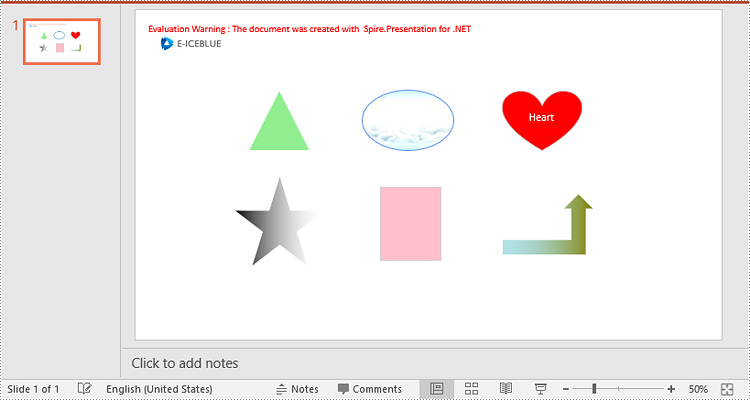
You can easily add various types of shapes such as rectangles, circles, triangles, arrows, and eclipses to a PowerPoint Presentation by using the ISlide.Shapes.AppendShape(ShapeType shapeType, RectangleF rectangle) method provided by Spire.Presentation for .NET. The detailed steps are as follows:
- Initialize an instance of the Presentation class.
- Load a PowerPoint presentation using Presentation.LoadFromFile(string fileName) method.
- Get a specific slide using Presentation.Slides[int index] property.
- Append various types of shapes to the slide using ISlide.Shapes.Append(ShapeType shapeType, RectangleF rectangle) method and then set styles for the shapes.
- Save the PowerPoint presentation using the Presentation.SaveToFile(string fileName, FileFormat fileFormat) method.
- C#
- VB.NET
using Spire.Presentation;
using Spire.Presentation.Drawing;
using System.Drawing;

namespace AddShapes
{
    internal class Program
    {
        static void Main(string[] args)
        {
            //Initialize an instance of the Presentation class
            Presentation presentation = new Presentation();
            //Load a PowerPoint presentation
            presentation.LoadFromFile("Input.pptx");

            //Get the first slide
            ISlide slide = presentation.Slides[0];

            //Append a triangle shape to the slide
            IAutoShape shape = slide.Shapes.AppendShape(ShapeType.Triangle, new RectangleF(185, 130, 100, 100));
            //Fill the shape with solid color
            shape.Fill.FillType = FillFormatType.Solid;
            shape.Fill.SolidColor.Color = Color.LightGreen;
            //Set the outline color for the shape
            shape.ShapeStyle.LineColor.Color = Color.White;

            //Append an ellipse shape to the slide
            shape = slide.Shapes.AppendShape(ShapeType.Ellipse, new RectangleF(370, 130, 150, 100));
            //Fill the shape with picture
            string picUrl = @"bg.png";
            shape.Fill.FillType = FillFormatType.Picture;
            shape.Fill.PictureFill.Picture.Url = picUrl;
            shape.Fill.PictureFill.FillType = PictureFillType.Stretch;
            //Set the outline color for the shape
            shape.ShapeStyle.LineColor.Color = Color.CornflowerBlue;

            //Append a heart shape to the slide
            shape = slide.Shapes.AppendShape(ShapeType.Heart, new RectangleF(600, 130, 130, 100));
            //Add text to the shape
            shape.TextFrame.Text = "Heart";
            //Fill the shape with solid color
            shape.Fill.FillType = FillFormatType.Solid;
            shape.Fill.SolidColor.Color = Color.Red;
            //Set the outline color for the shape
            shape.ShapeStyle.LineColor.Color = Color.LightGray;

            //Append a five-pointed star shape to the slide
            shape = slide.Shapes.AppendShape(ShapeType.FivePointedStar, new RectangleF(160, 270, 150, 150));
            //Fill the shape with gradient color
            shape.Fill.FillType = FillFormatType.Gradient;
            shape.Fill.SolidColor.Color = Color.Black;
            //Set the outline color for the shape
            shape.ShapeStyle.LineColor.Color = Color.White;

            //Append a rectangle shape to the slide
            shape = slide.Shapes.AppendShape(ShapeType.Rectangle, new RectangleF(400, 290, 100, 120));
            //Fill the shape with solid color
            shape.Fill.FillType = FillFormatType.Solid;
            shape.Fill.SolidColor.Color = Color.Pink;
            //Set the outline color for the shape
            shape.ShapeStyle.LineColor.Color = Color.LightGray;

            //Append an arrow shape to the slide
            shape = slide.Shapes.AppendShape(ShapeType.BentUpArrow, new RectangleF(600, 300, 150, 100));
            //Fill the shape with gradient color
            shape.Fill.FillType = FillFormatType.Gradient;
            shape.Fill.Gradient.GradientStops.Append(1f, KnownColors.Olive);
            shape.Fill.Gradient.GradientStops.Append(0, KnownColors.PowderBlue);
            //Set the outline color for the shape
            shape.ShapeStyle.LineColor.Color = Color.White;

            //Save the result PowerPoint presentation
            presentation.SaveToFile("AddShapes_result.pptx", FileFormat.Pptx2010);
            presentation.Dispose();
        }
    }
}
Apply for a Temporary License
If you'd like to remove the evaluation message from the generated documents, or to get rid of the function limitations, please request a 30-day trial license for yourself.
C#/VB.NET: Set Background Color or Picture for PowerPoint Slides
2023-08-07 09:03:00 Written by KoohjiSetting a background for slides is a crucial step in creating a visually appealing and impactful presentation. A well-designed background can provide a consistent visual theme, drawing your audience's attention and keeping them engaged throughout your presentation. In this article, we will demonstrate how to set background color or picture for PowerPoint slides in C# and VB.NET using Spire.Presentation for .NET library.
- Set a Background Color for a PowerPoint Slide in C# and VB.NET
- Set a Gradient Background for a PowerPoint Slide in C# and VB.NET
- Set a Background Picture for a PowerPoint Slide in C# and VB.NET
- Set a Background for a Slide Master in PowerPoint in C# and VB.NET
Install Spire.Presentation for .NET
To begin with, you need to add the DLL files included in the Spire.Presentation for.NET package as references in your .NET project. The DLL files can be either downloaded from this link or installed via NuGet.
PM> Install-Package Spire.Presentation
Set a Background Color for a PowerPoint Slide in C# and VB.NET
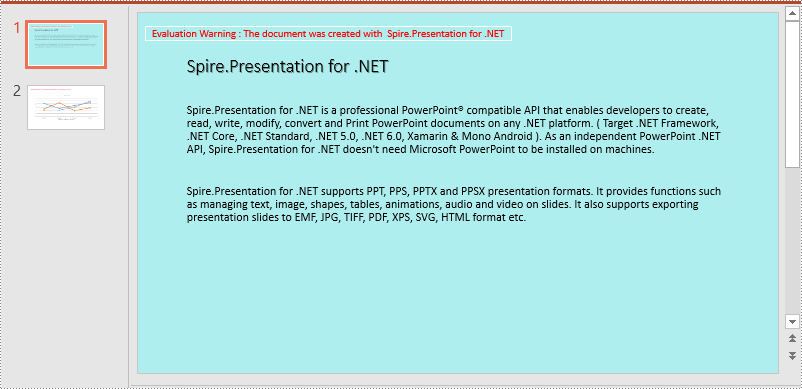
Adding a background color for a PowerPoint slide is very simple. You just need to set the fill mode of the slide’s background as a solid fill and then set a color for the slide’s background. The detailed steps are as follows:
- Initialize an instance of the Presentation class.
- Load a PowerPoint presentation using Presentation.LoadFromFile() method.
- Get a specific slide using Presentation.Slides[int index] property.
- Access the background of the slide using ISlide.SlideBackground property.
- Set the type of the slide's background as a custom type using SlideBackground.Type property.
- Set the fill mode of the slide’s background as a solid fill using SlideBackground.Fill.FillType property.
- Set a color for the slide’s background using SlideBackground.Fill.SolidColor.Color property.
- Save the result presentation using Presentation.SaveToFile() method.
- C#
- VB.NET
using Spire.Presentation;
using Spire.Presentation.Drawing;
using System.Drawing;

namespace SolidBackground
{
    internal class Program
    {
        static void Main(string[] args)
        {
            //Initialize an instance of the Presentation class
            Presentation ppt = new Presentation();
            //Load a PowerPoint presentation
            ppt.LoadFromFile("Sample.pptx");

            //Get the first slide
            ISlide slide = ppt.Slides[0];

            //Access the background of the slide
            SlideBackground background = slide.SlideBackground;

            //Set the type of the slide's background as a custom type
            background.Type = BackgroundType.Custom;
            //Set the fill mode of the slide's background as a solid fill
            background.Fill.FillType = FillFormatType.Solid;
            //Set a color for the slide's background
            background.Fill.SolidColor.Color = Color.PaleTurquoise;

            //Save the result presentation
            ppt.SaveToFile("Solidbackground.pptx", FileFormat.Pptx2013);
            ppt.Dispose();
        }
    }
}
Set a Gradient Background for a PowerPoint Slide in C# and VB.NET
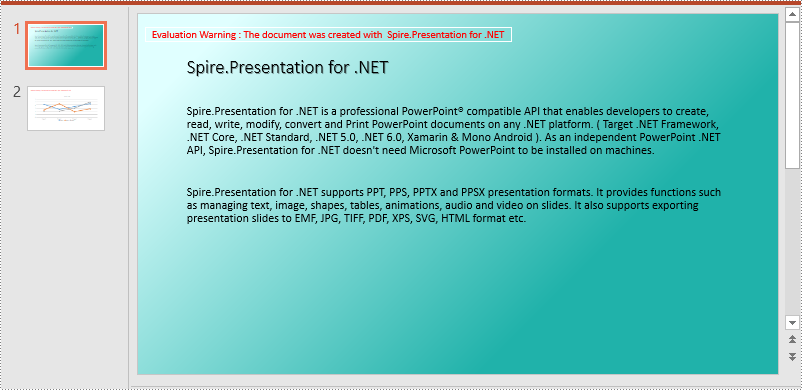
Adding a gradient background is a little complex. You need to set the fill mode of the slide’s background as a gradient fill and then set the gradient stops and colors. The detailed steps are as follows:
- Initialize an instance of the Presentation class.
- Load a PowerPoint presentation using Presentation.LoadFromFile() method.
- Get a specific slide using Presentation.Slides[int index] property.
- Access the background of the slide using ISlide.SlideBackground property.
- Set the type of the slide's background as a custom type using SlideBackground.Type property.
- Set the fill mode of the slide’s background as a gradient fill using SlideBackground.Fill.FillType property.
- Set gradient stops and colors for the slide’s background using SlideBackground.Fill.Gradient.GradientStops.Append() method.
- Set the shape type and angle for the gradient fill.
- Save the result presentation using Presentation.SaveToFile() method.
- C#
- VB.NET
using Spire.Presentation;
using Spire.Presentation.Drawing;
using System.Drawing;

namespace GradientBackground
{
    internal class Program
    {
        static void Main(string[] args)
        {
            //Initialize an instance of the Presentation class
            Presentation ppt = new Presentation();
            //Load a PowerPoint presentation
            ppt.LoadFromFile("Sample.pptx");

            //Get the first slide
            ISlide slide = ppt.Slides[0];

            //Access the background of the slide
            SlideBackground background = slide.SlideBackground;

            //Set the type of the slide's background as a custom type
            background.Type = BackgroundType.Custom;
            //Set the fill mode of the slide's background as a gradient fill
            background.Fill.FillType = FillFormatType.Gradient;

            //Set gradient stops and colors
            background.Fill.Gradient.GradientStops.Append(0.1f, Color.LightCyan);
            background.Fill.Gradient.GradientStops.Append(0.7f, Color.LightSeaGreen);

            //Set the shape type of the gradient fill
            background.Fill.Gradient.GradientShape = GradientShapeType.Linear;
            //Set the angle of the gradient fill
            background.Fill.Gradient.LinearGradientFill.Angle = 45;

            //Save the result presentation
            ppt.SaveToFile("Gradientbackground.pptx", FileFormat.Pptx2013);
            ppt.Dispose();
        }
    }
}
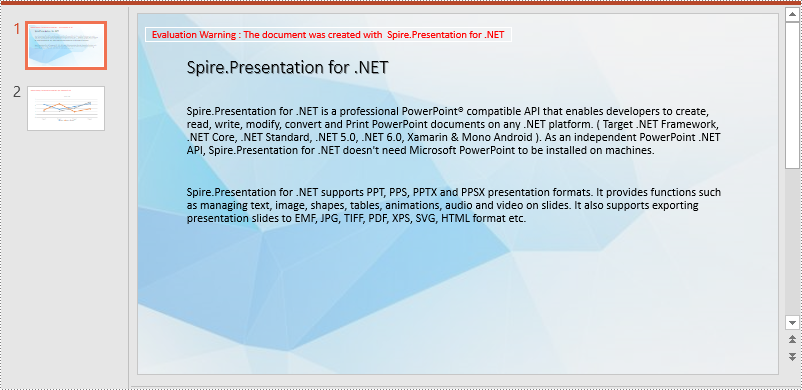
Set a Background Picture for a PowerPoint Slide in C# and VB.NET
To add a background picture for a PowerPoint slide, you need to set the fill mode of the slide’s background as a picture fill, then add a picture to the image collection of the presentation and set it as the slide’s background. The detailed steps are as follows:
- Initialize an instance of the Presentation class.
- Load a PowerPoint presentation using Presentation.LoadFromFile() method.
- Get a specific slide using Presentation.Slides[int index] property.
- Access the background of the slide using ISlide.SlideBackground property.
- Set the type of the slide's background as a custom type using SlideBackground.Type property.
- Set the fill mode of the slide’s background as a picture fill using SlideBackground.Fill.FillType property.
- Add an image to the image collection of the presentation using Presentation.Images.Append() method.
- Set the image as the slide’s background using background.Fill.PictureFill.Picture.EmbedImage property.
- Save the result presentation using Presentation.SaveToFile() method.
- C#
- VB.NET
using Spire.Presentation;
using Spire.Presentation.Drawing;
using System.Drawing;

namespace PictureBackground
{
    internal class Program
    {
        static void Main(string[] args)
        {
            //Initialize an instance of the Presentation class
            Presentation ppt = new Presentation();
            //Load a PowerPoint presentation
            ppt.LoadFromFile("Sample.pptx");

            //Get the first slide
            ISlide slide = ppt.Slides[0];

            //Access the background of the slide
            SlideBackground background = slide.SlideBackground;

            //Set the type of the slide's background as a custom type
            background.Type = BackgroundType.Custom;
            //Set the fill mode of the slide's background as a picture fill
            background.Fill.FillType = FillFormatType.Picture;

            Image img = Image.FromFile("bg.jpg");
            //Add an image to the image collection of the presentation
            IImageData image = ppt.Images.Append(img);
            //Set the image as the slide's background
            background.Fill.PictureFill.FillType = PictureFillType.Stretch;
            background.Fill.PictureFill.Picture.EmbedImage = image;

            //Save the result presentation
            ppt.SaveToFile("Picturebackground.pptx", FileFormat.Pptx2013);
            ppt.Dispose();
        }
    }
}
Set a Background for a Slide Master in PowerPoint in C# and VB.NET
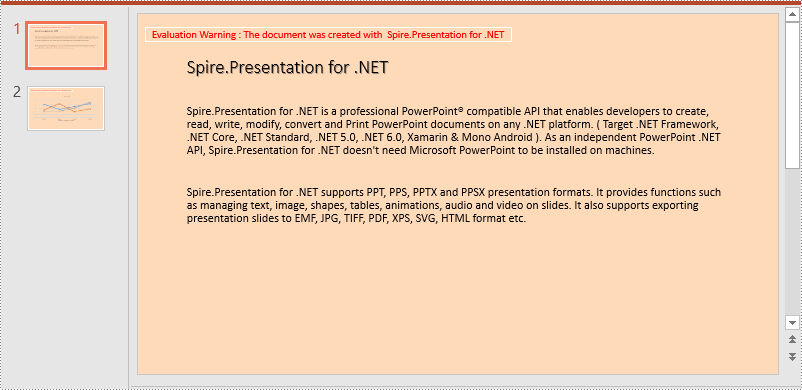
If you don’t wish to set backgrounds for slides one by one, you can set a background for the slide master, then all slides using the same slide master will be applied with the background automatically. The following steps show how to set a solid background color for a slide master:
- Initialize an instance of the Presentation class.
- Load a PowerPoint presentation using Presentation.LoadFromFile() method.
- Get a specific slide master using Presentation.Masters[int index] property.
- Access the background of the slide using ISlide.SlideBackground property.
- Set the type of the slide's background as a custom type using SlideBackground.Type property.
- Set the fill mode of the slide’s background as a solid fill using SlideBackground.Fill.FillType property.
- Set a color for the slide’s background using SlideBackground.Fill.SolidColor.Color property.
- Save the result presentation using Presentation.SaveToFile() method.
- C#
- VB.NET
using Spire.Presentation;
using Spire.Presentation.Drawing;
using System.Drawing;

namespace AddBackgroundToSlideMaster
{
    internal class Program
    {
        static void Main(string[] args)
        {
            //Initialize an instance of the Presentation class
            Presentation ppt = new Presentation();
            //Load a PowerPoint presentation
            ppt.LoadFromFile("Sample.pptx");

            //Get the first slide master
            IMasterSlide slide = ppt.Masters[0];

            //Access the background of the slide
            SlideBackground background = slide.SlideBackground;

            //Set the type of the slide's background as a custom type
            background.Type = BackgroundType.Custom;
            //Set the fill mode of the slide's background as a solid fill
            background.Fill.FillType = FillFormatType.Solid;
            //Set a color for the slide's background
            background.Fill.SolidColor.Color = Color.PeachPuff;

            //Save the result presentation
            ppt.SaveToFile("AddBackgroundToSlideMaster.pptx", FileFormat.Pptx2013);
            ppt.Dispose();

        }
    }
}
Apply for a Temporary License
If you'd like to remove the evaluation message from the generated documents, or to get rid of the function limitations, please request a 30-day trial license for yourself.
