Knowledgebase (2609)
Children categories
A simple PDF List is always one level list which displays briefly the content items of a PDF file. When the PDF is very huge and complex, people need more details, creating multiple level list in PDF becomes pretty necessary. Here a solution will be introduced to you about how to create multiple level list in PDF via a .NET PDF component Spire.PDF for .NET in C#, VB.NET. First let us see the effect of PDF multiple level list as below picture:
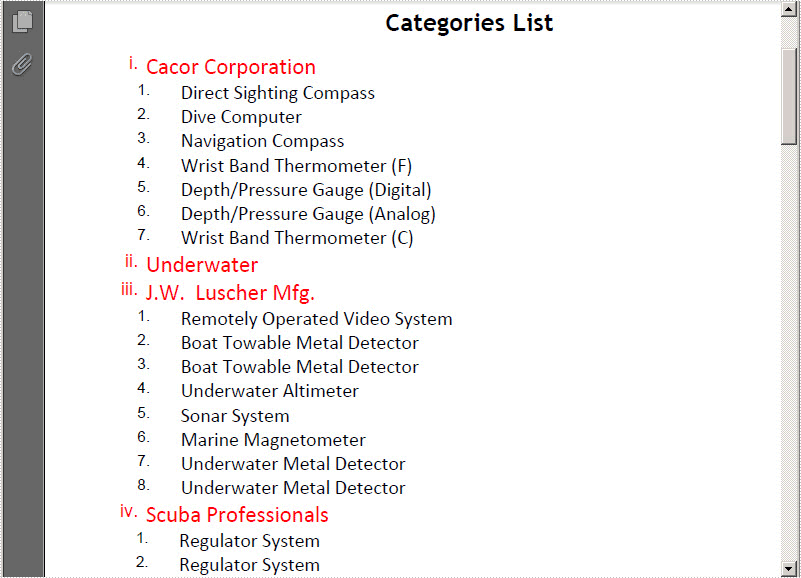
Here we can download Spire.PDF for .NET. After adding Spire.Pdf dll in project, please view below key code to start PDF list task.
In this solution, apart from creating PDF list, we also can set list format, position and layout. This class Graphics.PdfTrueTypeFont which is provided by Spire.PDF enables to set list font and size. From above picture, we can view that the first level list is red. It can be set in this class Spire.Pdf.Graphics.PdfLinearGradientBrush. In order to let users themselves to set PDF list style according to their needs, Spire.Pdf.Lists.PdfOrderedMarker can help us to set label style by this enum Spire.Pdf.PdfNumberStyle. Here there are six styles available: LowerLatin, LowerRoman, None, Numeric, UpperLatin and UpperRoman. In below code, I only show a part of code:
            //Set PDF list label style
            PdfOrderedMarker marker1
                = new PdfOrderedMarker(PdfNumberStyle.LowerRoman, new PdfFont(PdfFontFamily.Helvetica, 12f));
            PdfOrderedMarker marker2
                = new PdfOrderedMarker(PdfNumberStyle.Numeric, new PdfFont(PdfFontFamily.Helvetica, 10f));
'Set PDF list label style
Dim marker1 As New PdfOrderedMarker(PdfNumberStyle.LowerRoman, New PdfFont(PdfFontFamily.Helvetica, 12F))
Dim marker2 As New PdfOrderedMarker(PdfNumberStyle.Numeric, New PdfFont(PdfFontFamily.Helvetica, 10F))
After setting the PDF list format, we can search data in database by System.Data.Oledb.OleDbCommand and then, create multi-level list by two classes in Spire.Pdf: Spire.Pdf.Lists. PdfListItem and Spire.Pdf.Lists. PdfSortedList. The former class represents list item while the later represents the ordered list.
           //Create multi-level list in PDF
            PdfSortedList vendorList = new PdfSortedList(font2);
            vendorList.Indent = 0;
            vendorList.TextIndent = 5;
            vendorList.Brush = brush2;
            vendorList.Marker = marker1;
            using (OleDbConnection conn = new OleDbConnection())
            {
                conn.ConnectionString = @"Provider=Microsoft.Jet.OLEDB.4.0;Data Source=demo.mdb";
                OleDbCommand command = new OleDbCommand();
                command.CommandText
                    = " select VendorNo, VendorName from vendors ";
                command.Connection = conn;
                OleDbCommand command2 = new OleDbCommand();
                command2.CommandText
                    = " select Description from parts where VendorNo = @VendorNo";
                command2.Connection = conn;
                OleDbParameter param = new OleDbParameter("@VendorNo", OleDbType.Double);
                command2.Parameters.Add(param);
                conn.Open();
                OleDbDataReader reader = command.ExecuteReader();
                while (reader.Read())
                {
                    double id = reader.GetDouble(0);
                    PdfListItem item = vendorList.Items.Add(reader.GetString(1));
                    PdfSortedList subList = new PdfSortedList(font3);
                    subList.Marker = marker2;
                    subList.Brush = brush3;
                    item.SubList = subList;
                    subList.TextIndent = 20;
                    command2.Parameters[0].Value = id;
                    using (OleDbDataReader reader2 = command2.ExecuteReader())
                    {
                        while (reader2.Read())
                        {
                            subList.Items.Add(reader2.GetString(0));
                        }
                    }
                    String maxNumberLabel = Convert.ToString(subList.Items.Count);
                    subList.Indent = 30 - font3.MeasureString(maxNumberLabel).Width;
                }
            }
'Create multi-level list in PDF
Dim vendorList As New PdfSortedList(font2)
vendorList.Indent = 0
vendorList.TextIndent = 5
vendorList.Brush = brush2
vendorList.Marker = marker1
Using conn As New OleDbConnection()
	conn.ConnectionString = "Provider=Microsoft.Jet.OLEDB.4.0;Data Source=demo.mdb"
	Dim command As New OleDbCommand()
	command.CommandText = " select VendorNo, VendorName from vendors "
	command.Connection = conn
	Dim command2 As New OleDbCommand()
	command2.CommandText = " select Description from parts where VendorNo = @VendorNo"
	command2.Connection = conn
	Dim param As New OleDbParameter("@VendorNo", OleDbType.[Double])
	command2.Parameters.Add(param)
	conn.Open()
	Dim reader As OleDbDataReader = command.ExecuteReader()
	While reader.Read()
		Dim id As Double = reader.GetDouble(0)
		Dim item As PdfListItem = vendorList.Items.Add(reader.GetString(1))
		Dim subList As New PdfSortedList(font3)
		subList.Marker = marker2
		subList.Brush = brush3
		item.SubList = subList
		subList.TextIndent = 20
		command2.Parameters(0).Value = id
		Using reader2 As OleDbDataReader = command2.ExecuteReader()
			While reader2.Read()
				subList.Items.Add(reader2.GetString(0))
			End While
		End Using
		Dim maxNumberLabel As [String] = Convert.ToString(subList.Items.Count)
		subList.Indent = 30 - font3.MeasureString(maxNumberLabel).Width
	End While
End Using
Finally, if we want to make sure that PDF multi-level list fits the page perfectly, we need to set the PDF text layout. When doing this you can call this method: Spire.Pdf.Graphics.PdfLayoutResult.Draw(PdfPageBase page, PointF location, PdfTextLayout format); there are three parameters passed, one is to draw text in PDF page, another is to set text location, and the last one is to set text layout.
            //Set PDF Layout and position
            PdfTextLayout textLayout = new PdfTextLayout();
            textLayout.Break = PdfLayoutBreakType.FitPage;
            textLayout.Layout = PdfLayoutType.Paginate;
            vendorList.Draw(page, new PointF(0, y), textLayout);
'Set PDF Layout and position
Dim textLayout As New PdfTextLayout()
textLayout.Break = PdfLayoutBreakType.FitPage
textLayout.Layout = PdfLayoutType.Paginate
vendorList.Draw(page, New PointF(0, y), textLayout)
Spire.PDF for .NET is a .NET PDF component that enables you to create, read, edit and handle PDF files in C#, VB.NET.
Users can change Word view mode according to own reading habit. This guide introduces a solution to set Word view modes in C# and VB.NET.
There are several Word View Modes provided with customers, including Print Layout, Web Layout, Full Screen, Draft, Outline and Zoom in/out with specified percentage. The view mode can be selected when opening to make the document to be presented to match readers’ reading habit. This guide focuses on demonstrating how to set Word view mode in C# and VB.NET via Spire.Doc for .NET. The screenshot presents the result after setting Word view mode.
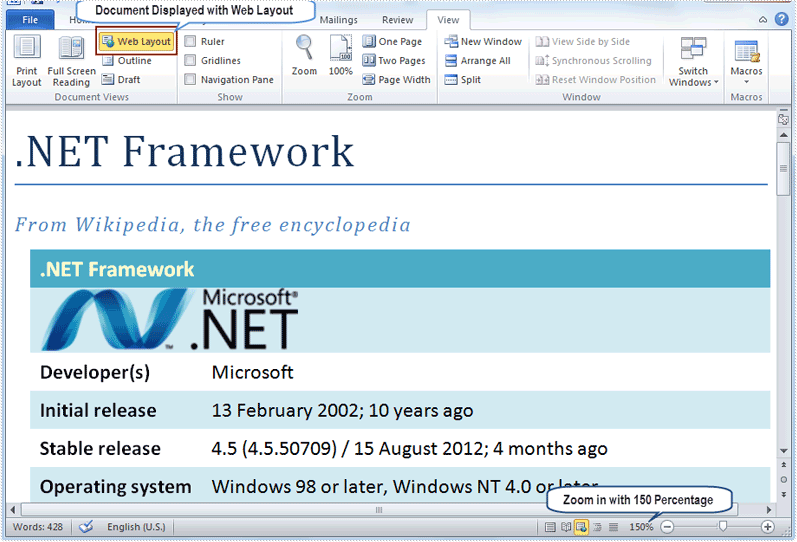
Spire.Doc for .NET, specializing in operating Word in .NET, offers a ViewSetup class to enable users to set Word view modes through assigning specified values for its properties. In this example, the Word view modes will be set as Web Layout with zoom out 150 percent. Therefore, the set properties of ViewSetup class include DocumentViewType, ZoomPercent and ZoomType.
DocumentViewTyp: There are five types provided by Spire.Doc for .NET: None, NormalLayout, OutlineLayout, PrintLayout and WebLayout.
ZoomPercent: The default ZoomPercent is 100. User can set other percent according to requirements. In this example, ZoomPercent is set as 150.
ZoomType: There are four zoom types provided by Spire.Doc for .NET: Full Page to automatically recalculate zoom percentage to fit one full page; None to use the explicit zoom percentage; PageWidth to automatically recalculate zoom percentage to fit page width; TextFit to automatically recalculate zoom percentage to fit text. Because the zoom percentage is set as 150, so the ZoomType is set as None in this example.
Download and install Spire.Doc for .NET and follow the code:
using Spire.Doc;

namespace WordViewMode
{
    class Program
    {
        static void Main(string[] args)
        {
            Document doc = new Document();
            doc.LoadFromFile(@"E:\Work\Documents\WordDocuments\.NET Framework.docx");

            doc.ViewSetup.DocumentViewType = DocumentViewType.WebLayout;
            doc.ViewSetup.ZoomPercent = 150;
            doc.ViewSetup.ZoomType = ZoomType.None;

            doc.SaveToFile("WordViewMode.docx", FileFormat.Docx2010);
            System.Diagnostics.Process.Start("WordViewMode.docx");
        }
    }
}
Imports Spire.Doc

Namespace WordViewMode
    Friend Class Program
        Shared Sub Main(ByVal args() As String)
            Dim doc As New Document()
            doc.LoadFromFile("E:\Work\Documents\WordDocuments\.NET Framework.docx")

            doc.ViewSetup.DocumentViewType = DocumentViewType.WebLayout
            doc.ViewSetup.ZoomPercent = 150
            doc.ViewSetup.ZoomType = ZoomType.None

            doc.SaveToFile("WordViewMode.docx", FileFormat.Docx2010)
            System.Diagnostics.Process.Start("WordViewMode.docx")
        End Sub
    End Class
End Namespace
Spire.Doc, professional Word component, is specially designed for developers to fast generate, write, modify and save Word documents in .NET, Silverlight and WPF with C# and VB.NET. Also, it supports conversion between Word and other popular formats, such as PDF, HTML, Image, Text and so on, in .NET and WPF platform.
Page margins are the distance from the page edges to the content area. They are helpful in making a document look neat and professional. When generating a document in Microsoft Word, you may need to set page margins to make the document look better. In this article, we will demonstrate how to set page margins for Word documents in C# and VB.NET using Spire.Doc for .NET.
Install Spire.Doc for .NET
To begin with, you need to add the DLL files included in the Spire.Doc for .NET package as references in your .NET project. The DLL files can be either downloaded from this link or installed via NuGet.
PM> Install-Package Spire.Doc
Set Page Margins in Word in C# and VB.NET
The following are the steps to set page margins in Word:
- Initialize an instance of Document class.
- Load a Word document using Document.LoadFromFile() method.
- Get the desired section through Document.Sections[sectionIndex] property.
- Set the top, bottom, left and right margins for the pages in the section through Section.PageSetup.Margins.Top, Section.PageSetup.Margins.Bottom, Section.PageSetup.Margins.Left, Section.PageSetup.Margins.Right properties.
- Save the result document using Document.SaveToFile() method.
- C#
- VB.NET
using Spire.Doc;

namespace PageMargins
{
    class Program
    {
        static void Main(string[] args)
        {
            //Create a Document instance
            Document document = new Document();
            //Load a Word document
            document.LoadFromFile(@"Sample.docx");

            //Get the first section
            Section section = document.Sections[0];

            //Set top, bottom, left and right page margins for the section
            section.PageSetup.Margins.Top = 17.9f;
            section.PageSetup.Margins.Bottom = 17.9f;
            section.PageSetup.Margins.Left = 17.9f;
            section.PageSetup.Margins.Right = 17.9f;

            //Save the result document
            document.SaveToFile("SetMargins.docx", FileFormat.Docx2013);
        }
    }
}
Apply for a Temporary License
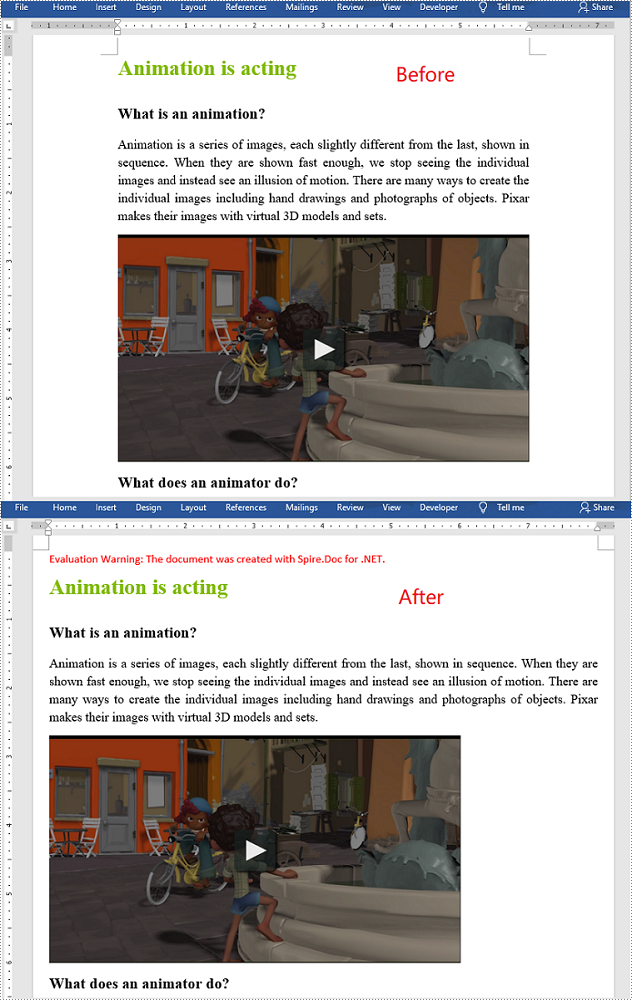
If you'd like to remove the evaluation message from the generated documents, or to get rid of the function limitations, please request a 30-day trial license for yourself.
